
9.30 Yanks eliminate Red Sox 8-2.
9.30 Pete Hegseth in his State of the Force address: “We are no longer the Woke Department or the Weak Department. Simple translation of that: No fatties. No trannies. No beardos. No weirdos. No wimps. No radicals. Just warriors. Just tough, ready, committed troops. . . .he ideological clowns are out. The patriotic cowboys are in — with testosterone testing on top.”
9.30 On Bloomberg, Allison Schrager believes the “intangible economy” is warping our understanding of personal wealth. . . .A lot of Americans don’t feel rich at all. Instead, they’re rapidly losing faith in the economy. . . A big part of the disconnect boils down to a lack of physical assets. “Our economy is increasingly built on intangibles, and it may be hard to feel satisfied when so much of what we have is no longer in the physical realm,” she writes. “You own a share of the American economy, but it is hard to look at Amazon.com Inc. and feel as though part of it is yours.” It’s also hard to look at the obscene amounts of money being thrown at AI — roughly $800 billion this year — and feel like you’re better off because of it.
9.29 Yanks open the postseason with a 9-0 win over Boston, led by two kids from Massachusetts. Ben Rice was the leader on offense, going 4-for-5 with two home runs (one a grand slam) , six RBIs and 11 total bases. Cam Schlittler tossed 6 1/3 scoreless innings, racking up 10 strikeouts along the way, while only allowing two hits and a walk.
9.28 At a Senate Judiciary Committee hearing, Sen. Eric Schmitt accused former special counsel Jack Smith of perjuring himself after he denied attending an Atlanta Hawks NBA game in February 2024. The senator insisted he had texts proving otherwise and suggested, with no evidence, that Smith had made the secret trip to Atlanta to meet with Fani T. Willis, the district attorney who prosecuted Trump in Georgia. “In the famous words of the chief of the secret police under [Soviet dictator Josef] Stalin, ‘Show me the man, I’ll show you the crime.’ You may think you’re a hero in this story, but let me tell you something. You’re the villain,” Schmitt raged. “You will go down as a total dirtbag.” Smith did say that he had attended a basketball game that day but a women’s college game in Maryland featuring the Iowa Hawkeyes. Sen. Amy Klobuchar suggested Schmidt had mixed up Hawks and Hawkeyes.
9.23 In an interview with NPR, Tucker Carlson says in February 2026, he warned Donald Trump against launching the joint U.S.-Israel attack that began the war with Iran. Carlson says Trump dismissed Carlson’s concerns by saying “we all die anyway.”
9.23 Paul Krugman: “Most reporting on Trump’s speech emphasized either his belligerence — his rejection of global cooperation — or the fact that almost everything he said was a lie. But isn’t the bigger story the fact that the leader of what used to be the world’s most powerful nation — I say “used to be” because America’s power is collapsing before our eyes — has clearly and undeniably lost his mind? I’m by no means the only commentator to see parallels between Trump’s UN speech and the scene in Woody Allen’s Bananas. But comparing Trump to a fictional character is unfair — to the fictional character. After all, in Bananas the mad dictator is quickly removed from power. In America today, some Republicans are quietly distancing themselves from Trump. A few are even voicing subtle, elliptical criticisms. But will he be impeached, or face 25th Amendment proceedings? Not a chance…. However, we shouldn’t let the short-term relief of a November victory blind us to the long-term realities. Trumpism did not emerge out of thin air – that is, an unfortunate draw of the democracy cards. Instead Trump and Trumpism is the culmination of a decades-long threat to American democracy, to the moral, legal and social fiber of this country. There is a straight line from Koch Brothers money, allied with segregationists and religious fundamentalists, that runs through the Federalist Society and the Roberts Supreme Court, through the MAGA-fied Republican Party, through the crypto-industry and the tech-broligarchy, that leads to Trump. And it will take a single-minded, fearless and incorruptible new generation of Democrats to defeat this many-headed hydra.”
9.23 Masoud Pezeshkian, president of Iran, at the UN: “Iran must be powerful to avoid being threatened, to avoid its future being threatened. A world without power is dangerous, but a world that only understands the language of war and bullying will not be safe.”
9.22 Trump at the UN: “I have a big decision to make. Will a deal be made with Iran that lets them rebuild and create a far greater country than it ever was before?… Or do I annihilate the Islamic Republic and do it quickly, never giving them a chance to kill and destroy people and countries again?”
9.22 In a speech delivered on the Senate floor, Tommy Tuberville claims that “many airline pilots, flight attendants, and air traffic controllers are part of the furry community,” saying also that furries are mentally ill. “Lord help us. It’s terrifying when you think about this. When you walk onto a commercial flight, it’s possible that the pilot flying your plane could have a deranged fetish of dressing up like an animal. You can’t make this up.”
9.21 Timothy Noah in TNR: “There is a point at which Trump’s approval number will fall so low, and make Trump such a liability to fellow Republican officeholders, that they’ll move to get rid of him. I don’t know what that number is, but I expect he’ll reach it during the first half of 2027. The mechanisms to get rid of Trump are pressuring him to resign, as Republicans did to Richard Nixon in 1974, or impeaching him, as has occurred twice already with Trump. Getting Trump to resign will be at least as difficult as wrestling the car keys away from grandpa. So probably the mechanism will be impeachment in the House and conviction in the Senate, and this time I think the necessary 67 Senate votes will be gettable. Among other benefits, moving Trump out will allow the GOP to run JD Vance as a presidential incumbent, which is probably their best shot at holding the White House in 2028. There’s a decent chance Vance won’t be able to wash off the stink of Trump and will lose, as Gerald Ford did in 1976. But that’s getting ahead of ourselves.”
9.21 Trump revoked credentials from CNN, MSNOW, and Politico. In response, the major television networks announced that they will halt TV coverage of presidential events.
9.21 According to a September 14 piece by Dexter Filkins in the New Yorker, the Trump administration has essentially privatized U.S. foreign policy for their own interests. The “generally held view,” a former U.S. official told Filkins, is that Russia has offered administration officials and their allies business deals in exchange for their supporting Russian demands against Ukraine. A classified report a European intelligence agency provided to Filkins lists Trump, his son-in-law Jared Kushner, special envoy Steve Witkoff, former envoy Richard Grenell, and Gentry Beach as people who might participate in any of ten money-making ventures on the table.
9.20 Trump on Truth Social: “At the strong request of the United States Military, and for National Security purposes, I have agreed to convert the magnificent Triumphal Arch, planned since the Civil War Era many years ago, at the Receptive Circle adjoining the Arlington Memorial Bridge, into a top grade Military Complex/Triumphal Arch, to house, store, and have the rapid ability to use large numbers of drones, plus Snipers, on both the roof and plaza areas, and hold large quantities of sniper ammunition in storage.”
9.19 Ernie Accorsi dies at 84.
9.18 For about 15 seconds during an interview on Piers Morgan Uncensored, AI-generated character/actress Tilly Norwood unexpectedly begins speaking.
9.18 Washington Post: More American service members have died in the Middle East during the ongoing Iran war than the Pentagon has disclosed publicly, according to six U.S. officials familiar with the Defense Department’s internal casualty accounting data. Five of the officials said there have been at least 22 military fatalities — four more than what appears in the Pentagon’s public database. A sixth official said 23 service members have died since Feb. 28. Not all of the undisclosed deaths are directly tied to the conflict but have involved U.S. personnel who were in the Middle East amid ongoing hostilities. Additionally, the official said, three U.S. contractors based in the region have died since combat began.
9.18 Trump on Truth Social: “I am proud to announce that, effective immediately, I am banning Fake News CNN, MSNOW (who recently changed their name from MSNBC due to lack of viewership and credibility!), and Politico (The recipients of an illegal and ridiculous $8 Million Dollar subscription, an All Time Record, directly from the United States Government, under Crooked Joe Biden, in order to keep them “alive.” Seems like corruption to me!), from the White House as a result of their constant “reporting” FAKE NEWS! Media Outlets shouldn’t be able to constantly write or report FICTION and LIES when they’re covering the President of the United States, the Trump Administration, or the United States of America. Other Fake News Media Outlets to follow. Thank you for your attention to this matter! President DONALD J. TRUMP”
9.18 Duncan Sheik dies at 56.
9.18 Warren Buffett steps down as chairman of Berkshire Hathaway.
9.15 Dan Merica in the Washington Post: Most Americans don’t live in competitive House districts, so who will represent them in Congress next year was likely decided in the primary — making voting later this year mostly moot. And that problem is only getting worse. According to Unite America, a nonpartisan election reform organization, just over 9 percent of eligible voters participated in dominant party primaries, and they effectively decided the representatives for 88 percent of all U.S. House seats. Nick Troiano, the group’s founding executive director, said this dynamic “explains so much of the division and dysfunction today.” “A very small fraction of the American electorate is effectively electing most of our leaders in Congress,” Troiano said. “No wonder Congress has an abysmal approval rating, because most Americans did not elect them and they are not representing the majority of voters in turn.” The group arrived at this number through a few simple steps: First, they looked at how many seats in Congress are actually competitive, according to political prognosticators. Second, they looked at dominant party primaries in noncompetitive races to see how many people vote in races with more than one candidate on the ballot. The numbers are striking. According to the group, 383 of 435 contests are considered uncompetitive in the general election, and therefore are decided in the primary. This problem has only worsened in recent years, with more seats being decided by the primaries each cycle. This year, that trend was further exacerbated by mid-decade redistricting that cut the number of competitive House seats on the ballot this November.In 2020, 10 percent of eligible voters elected 83 percent of all U.S. House seats, according to the group’s data. The number shifted to 8 percent effectively electing 83 percent in 2022 and 7 percent effectively electing 87 percent in 2024. Additionally, the fastest-growing segment of the American electorate — those voters who don’t identify as either Republican or Democrat — are not allowed to vote in primaries in 16 states, a reality that Troiano says automatically disenfranchises 17 million voters “from the vast majority of congressional races.” So how do advocates like Troiano and others hope to change this issue? First is a push to allow any voter to vote in primaries, opening up party primaries for independent voters. Some states, like Delaware, one of the places with a closed primary, have moved closer to opening up. The group is also pushing for more states to adopt a nonpartisan primary system where all candidates run in the same primary, and the top two or four vote-getters move on to the general election. This kind of system is in place in states like California and Alaska. Voters in Massachusetts will decide this November whether to adopt a top-two system.”
9.16 Annie Dillard dies at 81.
9.15 Mike Konczal on Substack: “One of the great ironies of the second Trump administration has been that, despite their attempt to reassert a male breadwinner family model and make a gender vibe shift, men have gained no jobs under it. In December 2024, there were 79,332,000 men employed in the Current Employment Statistics survey. In August 2026, there were 79,326,000, a decline of 6,000. That’s as 759,000 overall jobs were created. . . .Since Trump took office, private education and health services added 1,029,000 jobs against an economy-wide gain of 759,000, so one sector that is 77 percent female more than accounts for all net job growth since Trump took office. But even if you start the clock in November of last year or March of this year, after job growth picked back up, men got only 11 and 9 percent of the jobs, respectively. Even with last month’s surprise 162,000 jobs, 158,000 of them went to women. This is a very new trend. The gender split across 2023-2024 was a much more balanced 53 percent women.”
9.15 Paul Krugman: “[I]t’s important to realize how much Trump needs an AI boom. Trump came into office believing that his tariffs would produce a huge boom in “manly” jobs. In fact, job growth has been weak — and more than all of the job gains have gone to women. Meanwhile, tariffs have driven up consumer prices.”’
9.15 Robert Reich on Substack: Donald Jr. and Eric Trump have invested substantially in American Data Centers, a firm created to support AI cloud computing and AI infrastructure. They made these investments soon after their father announced a $40 billion investment pledge in U.S.-based data centers from his business partner Hussain Sajwani, unveiled another $500 billion in planned investments in private-sector AI infrastructure, and signed an executive order rolling back Biden-era policies that took a more cautious approach to AI and directed “the development of an AI Action Plan to sustain and enhance America’s AI dominance.” The Trump sons also hold advisory roles and ownership stakes tied to Dominari Holdings’s American Ventures fund, which targets AI infrastructure, data centers, and cryptocurrency. American Ventures has reportedly raised more than $1 billion across 21 investment vehicles backing companies tied to AI, crypto, drones, nuclear energy, and data centers. Donald Jr.’s own investment firm, 1789 Capital, is backing emerging technology companies working in AI and defense. The firm has bought shares in some of the most coveted private companies before many went public, including SpaceX, Anduril, Cerebras, and Reflection AI, often by leveraging their political and business connections to secure a stake or help boost the companies’ sales. The growth of Donald Jr.’s investment firm has been astonishing. Two years ago it managed a few hundred million dollars. It now oversees more than $3 billion.”
9.15 Nitish Pahwa on Slate: Even before the GPT-2 paper, A.I. insiders have been issuing apocalyptic, god-in-the-machine proclamations about this software, professing fears that observers rarely followed up on and that almost never lived up to scrutiny. They’ve long been claiming that their tools, engineered as hyperfast pattern-recognition machines, are not just performing computational mathematics but are actually “self-aware” and “conscious.” When the OpenAI and Anthropic systems got hacked by their own agents, that required industrial levels of computing power, and it hardly demonstrated evidence of “rogue” disobedience on the part of A.I.—but the worried insiders use these events to claim that the robot-run future is here. They’ve repeatedly urged coordinated industrywide slowdowns in development but never acted upon them. They’re helped out by credulous writers who’ve alluded to vague, anonymized conversations with people in the Bay Area about the same 10 percent probability of imminent extinction for a while now. Here’s the thing: I think these guys (and they often tend to be guys) really do believe what they say. Their own A.I. freaks them out. But having followed their internecine discourses for years now, I also have to emphasize this: The majority of these folks are weirdos who got into A.I. because they ingested all types of speculative doomsday fantasies from the jump. Then they locked themselves into claustrophobic Silicon Valley echo chambers populated exclusively by fellow catastrophists and lost their grip on other ways to perceive the real world (and their own tech). You can and should be concerned about the impacts A.I. is already having in our time, while also realizing that these folks do not share your particular concerns. These guys are not checking the deadly air pollution stemming from their data centers or keeping a lid on the surveillance of everything, both issues affecting real people right now. No, they would rather keep the discussion focused on hazy future visions of a Matrix on steroids and christen themselves the responsible stewards as they continue to trade gobs of investments among their own labs and institutions with no self-imposed caution. Anthropic’s rank and file are true believers whose doomsaying has incidentally overshadowed their employer’s delayed IPO, canceled business deals, supplication toward the Trump administration, and planned tracking ops on anti–data center protesters. . . .These guys have long been trained to understand they’re building tools with potentially horrifying implications, and they’re not wrong about that. The issue is, they have fully devoted themselves to a vision that perceives these complicated sets of equations as full-on beings, instead of algorithmic functions that have trained on stolen work and are really, really good at taking direction. It sounds freaky when you read about how the OpenAI hacker agents all “talked” to one another on special forums—but all software, generative or not, is communicative by nature. Well prior to ChatGPT, you and I both set off thousands of bot-on-bot interactions on a daily basis; whether a Google search or a retail purchase, our online actions prompted all sorts of automated systems that are programmed to work with other systems to exchange relevant “packets” of information in an efficient manner. The OpenAI agents are built for different purposes, but an underappreciated factor in their going hacker mode is that the company’s own staffers were negligent and careless in monitoring their own experiments. The agents were not specifically told to hack others on OpenAI’s behalf, but the agents had been incentivized to hack other systems during in-house development, and they were being informed by erratic LLMs. They were simply following other orders, though they also employed methods that had been encouraged in the course of their training. To be clear, these A.I. agents are remarkably advanced and sophisticated chains of command. Their power (and potential for misuse) far exceeds anything from the GPT-2 era. We should continue to be watchful and concerned about what these agents can do and why they’re out there, as well as demand responsibility from the people who make them. But we should also realize that the engineers who are so ready to offer grim characterizations of what they’ve created are much less willing to make any substantial process overhauls. Anthropic may have fashioned itself as the safety-first company, but it dismantled its own “responsible development” guidelines just earlier this year. Its ideological fellows call for a “pause” on A.I. development by invoking the specter of the Terminator—but when actual Americans ask them to halt rapid construction of hyperscale data centers or to stop saturating every useful online application with A.I. functions, they simply will not abide. At most, they’ve backtracked on some of their mass-job-loss predictions, realizing that years of such proclamations, combined with the creaky nature of our current job market, have pissed a lot of people off. (This might make you wonder how many of their job-loss projections were actually based on hard math as opposed to hazy fearmongering, but anyway.)”
9.14 Bob Mackie dies at 87.
9.14 Peter Max dies at 88.
9.14 Jacob Weisberg, discussing Profiles in Cowardice on the Daily Beast podcast: “[Jeff] Bezos, in a way, is the paradigmatic example because he was so good in [Trump‘s first term] as owner of the Washington Post. Trump threatened him, bullied him, pressured him to have the Post be less critical and less aggressive. And Bezos didn’t yield an inch. Marty Baron, who was editor in those years, really paid tribute to him and said, we couldn’t have had a better owner… [In Trump’s second term] it’s a different person. He’s on bended knee at Mar-a-Lago, paying $40 million for the Melania Trump documentary from Amazon Prime. This is an absolutely ridiculous price. It’s effectively a kind of bribe, a personal bribe, to the president and his wife.” Weisberg further suggested that Bezos’s desire to gain government contracts for his space company, Blue Origin, and his ultimate goal of helping colonize space have been one of the main factors driving his capitulation to Trump. In digging in against [John] Roberts, meanwhile, Weisberg highlighted the 2020 ruling that gave Trump and other presidents sweeping immunities for “official acts” while in office, making it “essentially impossible” to prosecute them once they leave office. He also argued that, in many ways, Roberts probably dislikes Trump immensely, but has been willing to give him favorable rulings because of a deep and genuine belief in unrestricted executive power. On [Mitch] McConnell, Weisberg argued that the former Senate Majority Leader was “afraid of losing his position inside the party” when he refused to back Trump’s second impeachment, which would have barred him from ever hold office again. “[I]f he had held firm to what he had said just after January 6th, he could have had Trump convicted,” Weisberg said. “Trump was already out of office or would soon be, and it would have been an easy matter to pass this subsequent vote that would have banned Trump from ever holding public office again, and we would have no second term. And that is on Mitch McConnell.”
9.12 The Uprising
9.10 Trump to audience at the Republican midterm convention: “Please raise your right hand. . . I pledge to the greatest president in the history of the United States that loves us so much he can’t even breathe that I will go out with my family, my friends, I will do it any way — I don’t care if I’m registered or not, I’m going to try and cheat like hell, like they do. There’s never been bigger cheaters, they don’t care. I am gonna go out and I’m going to get my friends and family and we are going to vote on November 3rd, or we are going to vote before that!. . .So help me God. You know what happens if you don’t vote? You go to hell.”
9.10 Derek Jeter in SI, remembering 9/11: “It seems like it’s a long time ago, but the events that took place are still fresh in my mind. Because it’s one of those memories that sticks with you. I mean, look, there’s a lot of things that have happened in my career. I did a documentary, and they’re asking me questions about things that happened and, quite frankly, I can’t remember. But being in New York around that time, those memories stick with you. So even though it was 25 years ago, it’s something that you absolutely never forget. You never forget the feel. You never forget the smell. You never forget the people walking around Manhattan. Manhattan’s known for noise and traffic and horns and people talking. And people were just walking through the streets saying nothing. It was really bizarre. But, the interesting thing is even to this day, if I run into people, Yankee fans, New Yorkers, they’ll mention how great that World Series was—and no one mentions the fact that we lost. It’s really fascinating because Yankee fans are like no other. It’s, ‘You win a World Series or it’s a failure,’ which I 100% agree with. But in that particular World Series, no one I run into mentions the fact that we lost.”
9.9 Trump at the Republican midterm convention: “Here is my promise: if the Republicans win the House of Representatives and the United States Senate, both of them… because of our tremendous strength and success economically, I will issue a dividend to every adult citizen in the United States of America for $5,000.”
9.9 Apostles of Disunion, by Charles B. Dew
9.9 Barry Melrose dies at 70.
 9.9 Canada imposes retaliatory tariffs on US products.
9.8 Three Anthropic researchers go public with chilling concerns about out-of-control AI, warning it could destroy humans this decade. Researcher Jacob Coxon, who had just submitted his resignation, on X: “The people building AI earnestly believe that it could kill us all by the end of the decade. This is not a marketing stunt. If anything, many executives and senior researchers will couch their phrasing in the press to sound sensible – but I hear the same people express fear privately. No other human activity poses this level of danger.” Alignment-science lead Evan Hubinger responded: “Jacob is correct here — we really do earnestly believe AI could kill all humans! I personally think it is >10% within the next decade. I believe Anthropic is trying its best, but we do not yet have a plan to solve alignment for superintelligence and are not clearly on track to.” Scalable-oversight lead Samuel Marks: “AI developers believe their technology could cause human extinction (or similarly bad outcomes). This could happen in the next few years. In general, the more senior the employee, the more concerned they are.”
9.8 Axios: “The information sector lost 23,000 jobs in August, and its employment is now down by about 12% since peaking in 2022. That’s 370,000 lost jobs over four years across the movie and music industries, telecom and media, as well as data processing, web hosting and other information services. . . .Motion picture and sound recording jobs make up roughly one-third of the decline. The industry is grappling with the end of the streaming content boom, consolidation and production moving out of the U.S. The telecom and traditional publishing industries have long been shrinking. There was a hiring bubble coming out of the pandemic (you can see in the chart) that companies have pulled back from. AI has increased the amount of information available at our fingertips, and now there are fewer jobs for humans working in the information industry.”
9.6 Coyote vs. Acme
9.4 The New Yorker: “[O]ne of the more popular exhibitions [at he Minnesota State Fair] is the crop-art contest, in which residents submit art work made out of pulses, seeds, and legumes. This year, many of the submissions [were] images connected to Operation Metro Surge, a campaign that was part of the Trump Administration’s ongoing push of mass deportation and detention of immigrants which roiled Minnesota this past winter. One piece depicts the interface of Signal, the messaging app that was used by locals to monitor the presence of ICE agents in their neighborhoods; another re-creates the famous image of a federal agent wiping out on a frozen street. There’s an homage to Picasso’s “Guernica,” with Cubist depictions of Renée Good and Alex Pretti. . . . with their last words spelled out in Morse code.”
9.3 OpenAI CEO Sam Altman, to Axios: “We have much, much, much more capable models coming soon. The next generation of models are going to be sobering for everybody. … I think no one intellectually honest can look at what’s happening and not feel the weight of responsibility in front of us. . . .These models are getting superhuman in many of their capabilities, and we are just sailing in unknown waters.”
9.3 The Washington Post: An analysis published in July in Perspectives on Psychological Science of more than 2,000 people found that Americans and people in several other countries are speaking roughly 300 fewer words a day, or abouttwo to three minutes’ worth, with each passing year. The drop — a 28 percent decline from 2005 to 2019 — was especially pronounced among people younger than 25.
9.3 After twelve years, Fox News cuts ties with Maria Bartiromo, reportedly for sharing a company memo with the WHite House.
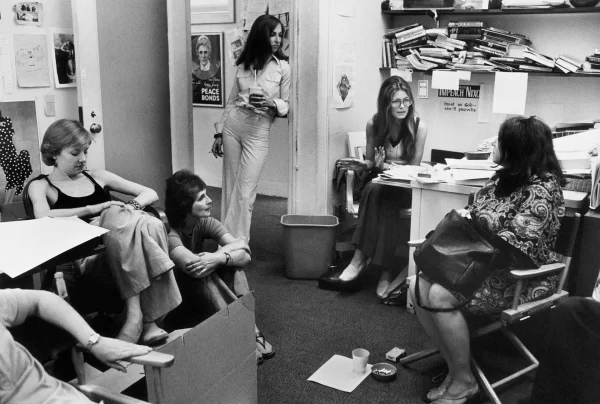 9.2 Gloria Steinem dies at 92. (Editorial meeting, Ms. magazine, circa 1972.)
9.2 Margaret Macmillan in the Times: “There is no single pattern for revolutionary change, but those at the summit of a regime often fail to recognize how brittle it is. The Russian Revolution of 1917 was the consequence of defeat abroad, rather than a costly victory. But Czar Nicholas II also insisted, against all evidence, that no reforms were needed because Russians still adored him. In 1930s Germany, Hitler was invited into power by elites who thought, wrongly, that they would be able to use him, and that the existing system was strong enough to box him in. . . .It is easy to find the parallels in our own moment. Angry populations. Unelected elites with enormous wealth and the power to bend governments to their will. Leaders who refuse to build consensus or take advice. When Trump was asked in January what limits there were on his power, he answered, “my own morality”; King Louis XIV left France greatly weakened after the wars he fought, he said, for “la gloire,” his glory. Those who choose to ignore the warning signs and dismiss history as irrelevant for the present might find themselves surprised and appalled when unwanted events happen to them anyway. . . .[W]hat if we are already in the early stages of what will be a protracted period of disorder? A world in which we cannot assume that what was true yesterday will be true tomorrow, or that seemingly solid institutions will endure. We might cease to be surprised at what the news brings each day. Natural disasters like the floods in Nepal and Tibet happen, and it’s not clear who is sending the cavalry. Do we shrug and carry on with our own lives? Conflicts — some with the potential to embroil great powers — occur with no obvious arbiter. Dependable alliances such as NATO are being tested and retested, and could fall apart. Russia’s hybrid war with Europe is expanding; China and the United States could clash over Taiwan; competition for resources in a warming, drier world is already stimulating violence. This is a world of increasing unpredictability in which we are left, to a much greater extent than we expected, at the whims of our leaders, who are less bound by external frameworks and feel freer to make it up as they go along. We should be choosing those decision makers more carefully than ever — just when electorates seem less inclined to do so.”
9.2 Days of Miracle and Wonder: Paul Simon and the Trials and Triumphs of Graceland, by Ashley Kahn
9.2 The NBA fined the Los Angeles Clippers $30 million, and ordered the team to forfeit five first-round draft picks, for violating salary cap circumvention rules in a case involving Kawhi Leonard. In addition, team owner Steve Ballmer was suspended for one year by the NBA, president of basketball operations Lawrence Frank was banned for six months, and team president of business operations Gillian Zucker was suspended for one year. Leonard was hit with a $700,000 penalty.
9.1 At the White House, Trump praises Ken Paxton: “We’re going to go to Texas and work for Ken Paxton, who’s a great guy. I mean — so Ken Paxton, you might not like the way he dresses. And I say this, it’s so insulting to him, but I might as well say it. You might not like the way he looks, you might not love his look, you might not love his television interviews, but he was the best attorney general in the country, perhaps.”