BUY THE BOOK


From the Award-winning series in the New York Times


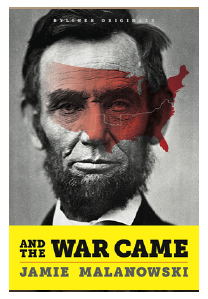
``This is an extraordinary collection, a hugely important deep-dive into the difficult waters of Civil War studies, done with provocative insight, great scholarship and truly original thinking. As we confront the hard truths and persistent relevance of the most important event in American history, on the occasion of its 150th anniversary, it's comforting to have And the War Came as a guide and a goad.''

Ken Burns, producer and director ofThe Civil War

“Jamie Malanowski does something fascinating in And the War Came. He writes a gripping account of the period after Lincoln’s election from the perspective of what people knew and felt during those months. Not only does this provide great insights into the outbreak of the Civil War, it also illuminates how the messy march of history actually works.”
Walter Isaacson, author of Benjamin Franklin, An American Life and Einstein: His Life and Universe


The Civil War is one of those events we think we know cold. But I guarantee you that Jamie Malanowski’s riveting, day-by-day chronicle of the lead-up to war will fill gaps you didn’t know you had, deepening and enriching your sense of the most politically consequential six months in American history. And the War Came is the next best thing to time travel.”
Kurt Andersen, author of Heyday


From Byliner Originals

``Jamie Malanowski brings a historian's eye and a journalist's ear to deliver a

breathtaking ride through America's most perilous year. Reading And the War

Came is like re-living the rise of Lincoln and the fall of national unity in

real time.''

— Harold Holzer, Chairman, Abraham Lincoln Bicentennial Foundation


`` The list of Civil War historians is frightfully long. But the truly able journalists among them are exceptionally few. And Jamie Malanowski, as readers of the inspired And the War Came will quickly discover, is not only on that short list, but perhaps somewhere very near the top.''

— Graydon Carter, Editor-in-Chief, Vanity Fair

``History happens, especially during national crises, in disjointed, unpredictable, and often utterly surprising ways. Jamie Malanowski's And the War Came, based on the New York Times's marvelous "Disunion" series, demonstrates with verve and riveting detail, how Americans collapsed into secession and war in 1860-61. Malanowski writes with informed clarity; this book will be a lasting record of our own commemorative moment as well as an enduring work of good history.''

— David W. Blight, Yale University, author of American Oracle: The Civil War in the Civil Rights Era


topic a, among others

DECEMBER 2,2011

SPRINGTIME FOR GINGRICH

Filed under: Politics — Jamie @ 8:53 pm


“For every Southern boy fourteen years old, not once but whenever he wants it, there is the instant when it’s still not yet two o’clock on that July afternoon in 1863,” wrote William Faulkner in Intruder in the Dust, speaking of the moment just before Pickett’s charge, when “this time, maybe this time” the Confederate forces will achieve a “desperate and unbelievable victory.” And for certain conservatives, now around sixty years old, there is an instant when it’s always 1994, and the rebel troops of Georgia’s Newt Gingrich, armed with the Contract for America, shellacked the Democrats and drove Bill Clinton into despair and confusion.

Well, we know what happened then. Within a few months, Timothy McVeigh took all the anti-Washington rhetoric seriously and blew up the federal building in Oklahoma City, and a few months after that Gingrich took all the anti-Washington rhetoric seriously and shut down the government, and that was it for the Republican counter-revolution. Clinton regained control, and governed for another term, despite a vast right-wing conspiracy to de-legitimate his election.

These days, those Gingrichites are in high clover, as by some measures the novelist/Tiffany’ Customer of the Year has taken the lead for the GOP presidential nomination. I wish them the joy of the moment, for it will all be over soon enough. Before long, it will be remembered that before Gingrich met this moment, he stood in line, suit-buttoned, hair-combed, resume suitably updated, while flibbertigibbet Republicans swooned for Sarah Palin, Donald Trump, Michelle Bachmann, Rick Perry and Herman Cain– in short, pretty nearly anybody–to stand as an alternative to Mitt Romney. Newt is getting a shot now because there is practically no one else in the room. It is impossible to think that Gingrich would be in any way a factor in this race if any of these lightweights had caught fire, or if Jeb Bush or Chris Christie or some other real candidate were running. (Of course, all these other candidates looked strong before they had to actually run, so maybe they would have pulled an el foldo as well.)

Gingrich should not be underestimated. He could win the nomination. He presents himself forcefully and with great confidence, and he brings with him an air of authority. Having gone toe-to-toe with Bill Clinton, he will be able to face President Obama on an equal basis (maybe too much of an equal basis–Gingrich will have trouble looking respectful, and not looking like a condescending know-it-all.) But it says here that long before the election, Gingrich will implode. Seldom have we ever seen a public official more self-impressed and self-satisfied, more in love with his own voice and his own clever formulations, than Newt Gingrich.

He will blow himself up. He nearly did it the other day when he said “child labor laws are stupid.” Lurking with in that remark was the not unreasonable idea that teenagers could be given part-time jobs to teach them a work ethic, pride and responsibility. But Gingrich could not make that simple proposition. He had to throw a bomb. He had to insult a century-old accomplishment of the Progressive Era. He had to assert his own intelligence over all those who spend their lives thinking about children and education and work and poverty. He had to put himself forward as the sneering, snarling expert on everything. Why? He cannot stop himself. He believes he is the smartest man in any room in which he stands.

And that is why he is an idiot.


MUST READ

NOVEMBER 18,2011

ENOUGH!

“This country does in fact have a serious deficit problem. But the reality is that deficit was caused by two wars--unpaid for. It was caused by huge tax breaks for the wealthiest people in the country. It was caused by a recession as a result of the greed, recklessness, and illegal behavior on Wall Street. And if those are the causes of the deficit, I will be damed if we are going to balance the budget on the backs of the elderly, the sick, the children, and the poor. That's wrong.''-- Bernard Sanders, US Senator from Vermont


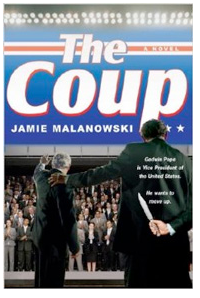
The Coup


Godwin Pope is the
Vice President of
the United States.
He wants to move up.


PLAY > America is talking about "The Coup"


A Romp Through the D.C. Underbrush

The New York Observer


Malanowski out-Buckleys Christopher Buckley.

The Wall Street Journal


A Carl Hiaasen-style take on Washington's greed and power lust.

Entertainment Weekly


A knowing dissection of the media-politics nexus

The Washington Post


The Coup is utterly entertaining, a smart, very 21st century Washington story. The surprise ending is not just a great surprise but witty and believable and altogether satisfying.

Kurt Andersen, author of Turn of the Century and Heyday


Jamie Malanowski has written a biting and hilarious satire of the Journalistic-Political Scandal Complex. A hapless president and a hooker. An evil, conniving vice president, and a journalist horny for her next big scoop. They fall in and out of power while they fall in and out of bed. Where does Malanowski come up with this stuff?

Paul Begala, contributor to CNN’s The Situation Room


Malanowski's portrait of a master political double-dealer is as entertaining as it is scary.

—Publishers’ Weekly

Malanowski's sardonic humour produces some neat one-liners, and makes Pope's masterly manipulation of his fellow politicians seem disturbingly believable.''

Telegraph.co.UK


The Coup [is] a Primary Colors for the Bush years.

Washington CEO magazine