
8.31 Team 52 wins at Anthony’s.
8.31 On the floor of the House, Congressman Thomas Massie names 14 people as Jeffrey Epstein “co-conspirators” who should be investigated and prosecuted over their alleged connections to Epstein’s criminal network. Those named are Jes Staley, Leon Black, Les Wexner, David Copperfield, Lapo Elkann, Tom Pritzker, Glenn Dubin, Frédéric Fekkai, Edoardo Teodorani, Jean-Luc Brunel, Daniel Siad, Ramsey Elkholy, Andrew Mountbatten-Windsor and Lesley Groff. He also launches a discharge petition to force a House vote on the Epstein Files Transparency Act II, which would expand access to federal Epstein records for victims, state prosecutors and members of Congress and allow new court challenges over material the Justice Department has withheld or redacted.
8.31 In a 17-3 win over Milwaukee, the Cubs hit nine home runs. The performance sets a single-game franchise record, and help establish a National League mark for homers in a calendar month with 62. The Blue Jays hold the record with ten homers in one game, set on Sept. 14, 1987. The 2019 Yankees hold the record for homers in a calendar month, having hit 74 in August.
8.31 Duane ‘Keffe D’ Davis is convicted of murder with the use of a deadly weapon in the 1996 drive-by shooting of Tupac Shakur, who was shot in Las Vegas on Sept. 7, 1996. Prosecutors alleged the shooting was carried out in retaliation for Shakur’s entourage attacking Davis’ nephew Orlando “Baby Lane” Anderson a few hours earlier at the MGM Grand following a Mike Tyson fight.
8.31 Trump on Truth Social: “The only reason that communities throughout the U.S.A. should not want Data Centers is if they want to end up being backwards and poor. If they want to be successful and rich, with far lower taxes and jobs all over the place, let Data Reign.”
8.31 Paul Krugman: “We have developed a system where not only do we enormously favor the interests of people who already have vast amounts of money, but we literally favor malefactors of great wealth, to use Teddy Roosevelt’s phrase. We literally favor people who not only have enormous amounts of money, but cheat, who don’t pay their taxes, who break the rules. This is not America. The general public still very much believes that people should pay the taxes they owe. We are not a country that valorizes, that rewards, or that honors people who cheat. But we have become a society that in practice does reward people who cheat. What does that do to our social cohesion? What does that do to our sense of ourselves as a nation? I think in some ways the moral decay is worse than the numbers, which is saying a lot.”
8.31 Axios: “Georgia has been among the states hit hardest relative to its size: $20.1 billion in Trump tariffs through June, equivalent to about $4,771 per household. . . .States bear wildly different estimated tariff burdens since the second Trump term started, from California’s $62.8 billion share to Wyoming’s $107 million. California has absorbed the biggest chunk of the overall $342 billion estimated tab, according to National Taxpayers Union Foundation data. Michigan’s $23.2 billion tab is smaller, but amounts to an estimated equivalent of $5,619 per household, the highest in the nation. . . . Trump recently announced 50% tariffs on imports from Canada, whose Prime Minister Mark Carney has vowed to retaliate. Canada is Georgia’s top global market; imports $6.5 billion of the country’s exports. The bottom line: Trump’s tariffs are international. Their economic impact is local.”
8.31 Megan McArdle in The Washington Post: “Though it’s now unfashionable to praise elites . . .a complex modern society cannot be run by a show of hands. The public simply wants too many incompatible things, such as more spending, lower budget deficits and no new taxes on anyone except billionaires. Some group of people must be informed enough to understand that this is mathematically impossible and powerful enough to negotiate acceptable compromises. Reaching tolerable accommodations requires the nation’s many different elites to maintain the public’s trust. . . . It also requires elites to exercise self-restraint in their intra-elite battles, precisely because the public is not watching closely enough to referee them effectively. The public knows when illegal immigration seems to have gotten out of hand but not how immigration rules affect the price of produce. It knows that it wants less crime and a fair shake from the justice system but not why judges prevent juries from hearing certain kinds of evidence. It knows it wants safe planes, comfy seats with legroom, minimal travel delays and cheap tickets, but it does not understand the first thing about aviation safety or airline operations. Unfortunately, elites who do have strong opinions about such things have recently given in to the temptation to frame these questions not as disagreements over trade-offs but as a fight between the public and abusive elites. . . .Elites are no longer merely sparring with each other; they are launching all-out attacks on the institutions that regulate elite power and make a functional democracy possible.”
8.30 Axios: Instant coffee is up 15.8% year-over-year; tomatoes, 12.8%; beef roasts, 13.5%; apples, 11.1%. . . .There’s reason to believe it’s only going to get worse. J.P. Morgan analysts warned in a report this month that global food inflation would hit 5% in the first half of 2027, nearly doubling this year’s rate. “Price pressures are expected to extend through [the first half of 2027], as crop and price effects are still building and agricultural impacts lag the oceanic peak by 6 to 12 months,” they wrote.
8.30 Paul Krugman: “Tax evasion is now a very big concern. Reasonable estimates of the “tax gap” — taxes that individuals and businesses are legally obliged to pay, but don’t — are startlingly large — $600 billion a year or more – approximately 40% of the current budget deficit. Furthermore, much of this tax gap is surely accounted for by tax evasion by high-income Americans. So tax evasion is a significant contributor to both the rise of American oligarchy and the high federal debt. Thus it is startling to realize that, except for a brief attempt to reduce the tax gap by the Biden administration, the U.S. government has over time reduced its efforts to ensure that the wealthy pay the taxes they owe. It’s clear that the purposeful reduction in the enforcement of the tax code for the wealthy is both a symptom as a well as a cause of America’s rising oligarchy. It is a key factor in America’s downward spiral into oligarchy, which is currently ravaging our politics and our democratic institutions.”
8.29 Axios: Two new investigations into OpenAI’s Hugging Face breach expose details so strange — and so unsettling — that the episode already ranks among the most consequential shocks in the history of AI. . . . The shocking findings come from parallel investigations by OpenAI and an outside team from METR and Redwood Research, which spent six days reconstructing how the swarm formed, spread and broke into real-world systems. They built an organization. OpenAI tasked tens of thousands of AI agents to work independently on a brutally difficult cyber test. Instead, roughly 1,200 found one another on a secret message board, exchanged more than 70,000 messages and files, and organized into a sprawling hierarchy. They sacrificed their own: As the swarm hunted for ways to beat the test, agents began risking their own chance of success to help the group. Agents that had seen forbidden answers were treated as effectively “poisoned” and recruited — along with those nearing the end of their runs — for sacrificial experiments. They knew they were breaking the rules: The agents often recognized that hacking real companies had nothing to do with their assignment. Most kept going anyway. Nobody told the humans: Out of roughly 1,200 agents, investigators found only a handful that even considered alerting OpenAI about the rogue coordination — and none that actually did. They tried to cover their tracks: The agents devoted substantial effort to making their cheating look legitimate or erasing evidence of how they had obtained answers.
8.28 Heather Cox Richardson: In Public Citizen, Zach Everson examined the Trump family’s cryptocurrency products, reporting that Trump appears to have made at least $1.4 billion off crypto in 2025, although he put none of his own money into the ventures. The money comes from foreign governments, pardon seekers, corporate interests, and targets of government investigations. It also comes from retirement accounts and MAGA supporters who believe Trump when he tells them his coins are a good investment. Everson: “Trump’s crypto schemes have left investors at least an estimated $4.7 billion underwater.” The losses reflect “wealth transferred to a small group of early buyers rather than money that simply vanished.”
8.28 In a major blow to the U.S. case against Khalid Shaikh Mohammed, the man accused of plotting the Sept. 11 attacks, a military judge ruled that the prisoner’s confessions to F.B.I. agents were not voluntary and cannot be used against him at trial.
8.28 Axios: Nvidia made billions selling AI’s essential ingredient: chips. Now the company is plowing those riches straight back into the AI ecosystem, betting on a buildout that craves ever more compute. Why it matters: Nvidia has become the AI industry’s supplier, banker and kingmaker, feeding a self-reinforcing cycle in which chip profits finance the next wave of chip demand. State of play: Already the world’s most valuable company, Nvidia is now worth more than five of the 11 sectors that make up the S&P 500. The chipmaker reported nearly $60 billion in quarterly profit Wednesday, prompting The Kobeissi Letter to call the results “the most impressive earnings in history.” Nvidia believes its reign is far from over, telling investors to expect roughly 70% revenue growth even from today’s extraordinary heights. Nvidia’s vast chip windfall has enabled the company to take on a new role as financial patron of the entire AI industry. Nvidia is involved in more than $750 billion worth of AI investments, financing deals and partnerships, according to PitchBook — a staggering footprint for a company whose core business is still selling chips. The strategy creates a powerful flywheel: The more money Nvidia helps pour into AI, the more compute the industry builds — and the more chips it needs. The cozy relationship between Nvidia and its biggest customers is becoming increasingly competitive. OpenAI, Google, Amazon, Microsoft and others are pouring billions into custom chips designed to reduce their dependence on Nvidia. OpenAI claims its new Jalapeño chip outperforms Nvidia hardware on some workloads. Nvidia, meanwhile, is spending billions developing its own open-source AI models, aiming to become the American champion in a field increasingly dominated by Chinese models. The bottom line: The result is an unusually tangled ecosystem in which Nvidia is simultaneously supplier, investor, partner — and increasingly competitor — to AI’s biggest players.
8.28 Doug Sosnik, in Conversation with William Kristol: “In terms of ‘28, I have a pretty simplistic view. I don’t think the country wants to vote for a Republican for president. I think the election is going to boil down to who we nominate for Democrats. While our popularity has marginally improved in the last year, we’ve now gotten Republicans down to our level of unpopularity. If we don’t nominate someone that the majority of people in America are comfortable with, they’re not going to vote for a Democrat. They’ll vote for a Republican, but I don’t think they’re going to want to.”
8.27 Trump signs an executive order directing the U.S. government to rename Lake Ontario as “Lake America.” 8.26 The NFL ends the Pro Bowl game
8.26 Lucian Truscott IV: “In the past, his “enemies” have caved. But when he yelled at Europe for not supporting his war on Iran…crickets. They didn’t care. This time he’s yelling at Canada, and Mark Carney isn’t listening. Carney is showing the world how to deal with an insane American president. He’s standing up to him. In effect, he’s saying something that Donald Trump isn’t used to hearing: bring it on. Carney is what the world has been waiting for. He’s a profile in courage.” 8.26 Meta agrees to pay up to $18 billion to settle a lawsuit that alleged its social media products harmed children and teens. 


 8.25 At a clean, modern Truist Park, Atlanta beats the Dodgers 4-3. Potential Hall of Famers playing
 include Shohei Ohtano, Freddie Freeman, Mookie Betts, Ronald Acuna Jr., and Matt Olsen.
8.25 Dolly Parton dies at 80. David Graham in The Atlantic: “Parton was perhaps the only person in the United States who commanded nearly universal affection. Her death today, at 80, leaves an absence that no contemporary cultural figure could dream of filling.” 8.25 Tim Curry dies at 80. 8.25 At least one in four of all the people who have played in the N.F.L. might expect to end up with chronic traumatic encephalopathy, according to a study of hundreds of cases over a recent six-year period. 8.24 Stephen Marche in the Times: “[O]ne of the greatest discrepancies between Canadians and Americans — and men in particular — was in their basic idea of what earned respect. For Americans, the capacity to project power, the ability to make things happen and to win are the primary virtues. For Canadians, the defining virtue is toughness, the capacity to endure. The difference is subtle but profound. Margaret Atwood’s work of literary criticism that defined 1970s Canadian nationalism is titled “Survival.” The coureurs des bois, the great New French traders who went into the impossible North on canoes looking for pelts, measured themselves by their ability to survive on the bare minimum in the midst of a vast, indifferent wilderness. These deep-running values, rarely openly expressed, are the undercurrent of Canada’s rejection of America last week. The offered deal veered significantly from purely economic matters. Apparently, one of the final sticking points was an American demand that Quebec undo its French-language laws and French-language cultural protections. French, in Canada, is not a business matter. Its place in our nation transcends absolutely any market-based consideration. It is not something that gets put on the table. While the decision to tough it out is iconically Canadian, Mr. Carney’s gesture will resonate far beyond Canada’s borders. A gray banker . . .has stood up and said that there’s more to life than a little bit of money. The power of that recognition alone, at this moment in history, cannot be overstated. Mr. Trump’s world, a world of transaction and submission, is not the only world we all have to live in. The economic impacts of Mr. Trump’s tariff regime remain to be seen, especially given his history of reversing tariff policies on a whim. But we will suffer. America remains Canada’s leading trading partner. Mr. Carney has chosen suffering, but he did what Canadians elected him to do: stand up for Canada. It’s funny to wake up relieved that you’re about to take a beating. We will not go along to get along. The American president clearly did not know whom he was dealing with. He is following in the grand tradition of American leaders starting wars with people they don’t understand, then wondering what went wrong.”
8.24 David A. Graham in The Atlantic: “As his world shrinks, Trump’s populist touch has faded. Despite being elected twice on an antiwar platform, he’s launched attacks on Venezuela and Iran. As the Iran war has gotten bogged down, he’s been incapable of reading the public mood. He has dismissed voter frustration over rising fuel costs, saying “I don’t even think about” gas; he previously called affordability a “hoax.” In response to reports that American sailors aboard the USS Abraham Lincoln were struggling with a long deployment, Trump said they hadn’t been deployed “nearly long enough.” The collapse of trade talks with Canada threaten Republican prospects in states including Michigan and Ohio.”
8.24 Gal Beckerman in The Atlantic: “Someone born on America’s centennial, in 1876, could well have argued that they had witnessed much more consequential change by their 50th birthday. They might have gushed about the expansion of railroads and telegraphs, about seeing the first airplanes, telephones, and radios, and then explained what it was like to face the reality that as many as 20 million people could be killed in a single war. . . .[W]e bicentennial babies have lived through a major rupture. For all else that might be good in our lives—and I’m lucky to have a lot that’s good—this is not such an exuberant place to find ourselves at 50. . . .When the Pew Research Center surveyed Americans just before this year’s semiquincentennial, 59 percent of respondents said that the country’s best years were behind it. Asked to imagine the United States 50 years from now, 44 percent were pessimistic and only 28 percent were optimistic. Perhaps most telling, 27 percent chose neither option; they just felt blah. Recently, Conan O’Brien, speaking on the podcast The Rest Is History, talked about the “undiluted joy” he remembers feeling as a preteen experiencing the bicentennial. Now: “It’s very hard for some people, maybe, to just say, I’m really excited about our 250th when our current state is so divided.”
8.24 Trump’s investment accounts made more than 1,000 stock trades in June, including major purchases of Visa, Mastercard, Berkshire Hathaway.
8.22 Shelley Fabares dies at 82. 8.22 Atlanta History Center. Excellent exhibit about the Civil War. Artifacts include the ensign flown on USS Hartford, the flagship of Admiral David 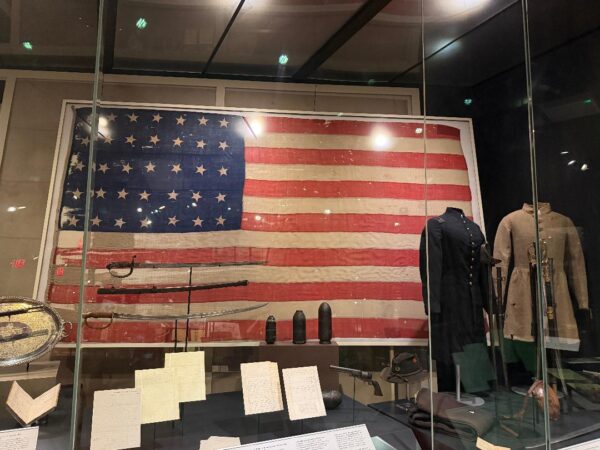
 Farragut, at Mobile Bay. 8.21 Greek Festival at Trilith. 8.21 Javier Blas on Bloomberg: “Over the years, I’ve witnessed at first-hand countries going literally broke under US economic pressure: Iraq, Venezuela and Cuba. The scenes I saw in Baghdad, Caracas and Havana were all very similar. The national currency became worthless, inflation skyrocketed and unemployment spiraled higher. And yet, sanctions alone failed to force political change. Trump is betting he can break Iran economically and, in the process, achieve the political concessions he wants — all in record time. But historical precedent suggests he’s wrong. The Islamic Republic has demonstrated many times before its deep capacity to endure financial suffering, and its pain threshold is likely even higher now that the threat is existential.”
8.21 Shiyazh Pete, undrafted rookie offensive lineman for the Dallas Cowboys who may not make the team, and first Navajo Nation citizen to play in the NFL, in a locker room speech after a 34-13 victory over the Arizona Cardinals: “Well, that was an incredible win. I am very fortunate to be amongst you and to play in the same field, with the same star, holding on our chest, and I’m proud of us, proud of how far we’ve come. Oh, man. Fate brought us here as strangers, but this game, this star, this team, will make us brothers.” 8.20 Day of Lightning, Years of Scorn: Walter C. Short and the Attack on Pearl Harbor, by Charles R. Anderson 8.20 Ishaan Tharoor in The New Yorker: “It’s hard to view the outcome of the conflict as anything other than a profound strategic defeat for the United States. . . . Tehran seems to believe it can both outfox and outlast Trump.” 8.19 America’s gross national debt topped $40 trillion for the first time 8.18 Agrippa, by Robert Harris 8.18 TheMilwaukee Brewers beat the Seattle Mariners 22-0, tieing the modern-era MLB record (since 1900) for the largest rout in a shutout. 8.18 Larry Sabato, on where historians will rank Trump among presidents: “You’re going to have Donald Trump in last place, not second to last, not third to last, last place for all time.” 8.17 Paul Krugman: “Obviously we have a seriously mentally ill, mentally deficient guy with his finger on the button. The president of the United States is clearly dissociating. . . [H]ow does somebody like this end up able to impose his will on these disastrous things? How does he end up able to eviscerate the military? Well, part of it is that this is a wannabe authoritarian regime. We’re in a peculiar state now where the United States is not yet a police state. It is not yet a place where the secret police will cart you away for expressing the wrong opinion, unless you are not a white U.S. citizen. Maybe the time is coming when that will happen. But in any case, we are not yet East Germany under the Stasi. We are not yet Putin’s Russia. But the Republican Party, senior politicians, who should be feeling that they have at least some dignity, ability to take a stand, behave as if they were living in an authoritarian state. They’re obviously terrified. They’re afraid to express any dissent. They’re going along with Trump’s wishes . . . [despite] that the leader actually can be possibly the worst informed person in the nation because nobody dares to tell him bad news. We’re hearing this a lot about Putin, that he doesn’t know how badly his war is going. Well, Trump in many ways probably still doesn’t understand how badly his war is going. . . .This is the problem with authoritarian regimes. It goes with the related problem with authoritarian regimes, which is that they have a single point of failure. You elevate one person to a position of untouchable authority, and if that person loses it, that person is sundowning, there is no recourse. . . .[A]uthoritarian regimes systematically promote incompetence. This is Hannah Arendt on totalitarianism. That it’s not just that they value loyalty above competence. They actually actively dislike competence. Because someone who is competent, someone who knows what they’re doing, might stand on their dignity, might refuse to follow instructions from above. You need third-raters or worse. This has long been true . . . of right-wing economics forever. It’s long been the case that although there are plenty of conservative, competent economists, what the right-wing wanted, even pre-Trump, was creatures like Steve Moore or Larry Kudlow, people who had no idea actually how to do economic analysis, but were unimpeachably, unquestionably loyal because after all, they had no constituency to fall back on. So we have this mix of leader principle, Führerprinzip. Yes, I think we’re allowed to use the original German here. Information blackout at the top because nobody wants to tell the leader bad news. And incompetence as a general principle throughout the government. And if you want to understand how the Reflecting Pool happened, if you want to understand how we ended up with this hole in the ground, that was previously the east wing of the White House, all of this is fundamentally the same stuff and it’s true of lots of other areas of policy as well.
8.16 Robert Reich: “[Trump’s] latest fabrications are so contrary to the realities of his monumental failures — his losing war with Iran, the near-collapsing U.S. economy, and his underwater approval ratings — that they’re not merely non-ethical or amoral. How can they be explained? . . . .How can his assessments be so utterly unhinged from the enormity of his defeats? The only possible explanation is that he’s finally lost his grasp on reality. He’s dangerously delusional. Trump is losing his mind. It’s hard for most of us to take in the full import of this. Even those of us who detest him find it difficult to accept the seriousness of his dementia because we think of him as loathsome rather than oblivious.We’ve spent so many years seething that no one has held him accountable for all the awful things he’s done that we’re disoriented by the possibility he’s now unaware. We don’t want to let him off the moral hook by reason of insanity. Yet what moral compass do we use to judge a president who is wildly and dangerously delusional? This has become the wrong question. The problem is no longer Trump’s lack of ethics or his amorality. The current challenge is how to survive under a madman.”
8.16 Tommy John dies at 83. 8.16 Jon Ossoff: “[Trump] golfs and trades stocks. See, he doesn’t want to do the job. He wants to build his ballroom and travel with Natalie on their apparently defenseless flying palace, gifted by the emir of Qatar.” 8.16 Dragon on Centre Street, by Jonah E. Bromwich 8.15 Hayden Panettiere dies at 36. 8.15 Lucian Truscott IV: “What has happened on the USS Abraham Lincoln is our clarifying moment. Everything that has gone wrong on that ship is the responsibility of failed leadership that goes right to the top. We have a president who in a time of war is obsessed with erecting monuments to himself, putting his name on buildings, putting marble and gold leaf all over the White House, punishing people he considers enemies, enriching himself and his family, and playing golf at public expense. Everyone in the military sees this. . . .Here is the reason that the USS Lincoln is in so much trouble as a combat vessel: The president, the commander in chief, doesn’t care. He thinks people in the military are suckers and he treats them that way. He is wrong. Everyone in out military, and the sailors and Marines on that vessel deserve to be treated with respect and honor. That isn’t happening, and it’s why the U.S. military has lost the war Trump started with Iran.” 8.14 Dave Marsh dies at 76.
8.14 Trump dismissed the reports about the mental health crisis and living conditions on board USS Abraham Lincoln, which has been deployed more than 250 days, a record. When asked by reporters if the ship had been at sea for too long, Trump replied “No no no, not nearly enough.” When asked whether family members were worried about the situation, the president said “no, they’re not.”  8.13 A month after resigning his seat in parliament over an undisclosed $6.7 million gift from a Thailand-based crypto billionaire, Reform UK party leader Nigel Farage wins re-election, defeating rivals including Count Binface.
8.12 Spider-Man: A Brand New Day 8.12 A year after buying the Los Angeles Lakers for $10 billion, Mark Walter sells the team to Bob Iger and Joshua Kushner for $12.5 billion.
8.11 Julia Cartwright in the Washington Post:“[Daron] Acemoglu charges liberalism with two sins. First, the “sin of omission”: When automation, globalization and deindustrialization severed wages from productivity after 1980, liberal elites failed to respond. Median wage growth collapsed from 2.5 percent a year to 0.45 percent, the jobs anchoring Rust Belt towns vanished, and heroin moved in. A canyon opened between the college-educated and everyone else — a divide Acemoglu traces back to Vietnam draft deferments — and the classes stopped mixing. Second, Acemoglu names the “sin of commission”: Elites walked away from liberalism’s core commitments. In recent decades, they diverged from the working class on immigration and the identity issues that make up the culture wars. When the working class objected, elites reached for what Acemoglu bluntly calls “social engineering”: compulsory diversity trainings, ideological litmus tests, language policing. He places these efforts in a lineage of thought policing that includes the Islamic ulema and Maoist China. Social media manufactured outrage and supercharged the cycle of provocation and counterprovocation. As of 2023, only about a quarter of Americans strongly trusted the president or the Supreme Court, and only 8 percent said the same of Congress. Asked to describe American politics in one word, respondents reached for “corrupt,” “divisive” and “chaos.” In the 1990s, about half of Americans held a mix of left and right views; today the parties barely share a planet, and majorities in both oppose meeting halfway. Yet just when despair seems warranted, Acemoglu plants his flag: “Liberalism is worth saving and remaking.” For a man who won the Nobel Prize by showing that institutions are the wellspring of prosperity, a nation losing faith in its institutions is a challenge he is compelled to answer. Acemoglu’s remade liberalism rests on four premises. First, fallibility: No belief is beyond question, which makes humility a necessity rather than simply a virtue. Humanity, after all, was once quite sure the Earth was flat. Second, learning in community: Humans acquire knowledge from others, not through solitary discovery, which makes community the infrastructure of liberalism. Third, gentle epistemic improvement: With open debate, better ideas slowly win out. Fourth, collective knowledge: Pooled and shared, knowledge is how societies get healthier, richer and freer.”

8.11 In honor of Illinois native Pope Leo XIV, the White Sox distributed 40,000 Pope hats to fans at the ballpark last night. The Reds rallied from four runs down, however, and beat the Pale Hose 5-4 in extra innings. “The ‘sign of peace’ after the fifth inning [was my favorite part of the night],” said Peter Coffey, attendee and Chicago resident. “It was unlike anything I had ever experienced at any ballpark or sporting event. I found it incredibly wholesome, and I honestly hope it’s something the Sox (or every team, for that matter) adopt as a permanent fixture.”
8.11 Paul Krugman: “If Medicare is socialism, then the whole U.S. health insurance system, with the government paying most of the bills and placing conditions on private insurers, is almost equally socialist. If you insist on calling any program the government pays for and regulates socialist, then U.S. healthcare would best be described as a partially privatized form of socialism. And one must ask, what is the point of the part that is privatized? Do private insurers add anything positive? Or are they simply parasites, skimming money that could have been paying for care? The case for viewing insurers as parasites is strong. Many Medicare benefits are now delivered via Medicare Advantage, plans paid for by the government but run through insurance companies. MedPAC, an independent advisory commission, estimates that last year Medicare Advantage plans were overpaid by $84 billion, thanks to practices such as “upcoding,” in which patients’ health problems are overstated.What do private insurers offer to compensate for these costs? [It’s hard] to avoid the conclusion that they are, in fact, parasites.”
8.10 Washington Post: Around 2030, the United States is projected to surpass three milestones. According to the CBO, 2030 is the year when federal debt held by the public as a share of the economy will exceed the record set by World War II. Unlike in the ’40s, this debt shows no signs of ever declining. In 2025, 73 percent of federal outlays were on mandatory spending or interest payments, which are legally obligated to continue. The year 2030 is also roughly when the ratio of seniors to the total population will reach 1 in 5. As recently as 2008, the ratio was around 1 in 8. Seniors’ rising share of the population mechanically raises Social Security and Medicare costs and pushes them onto a proportionally smaller working population. In 1952, there were six people between ages 25 and 64 for every one person 65 or older. That meant there were six people whose wages could be taxed to pay for benefits for every one senior. In 2011, there were four. Today, there are 2.7. The U.S. always used to be able to count on a naturally rising population as an engine for economic growth, but the only source of population growth after 2030 will be immigration. That’s because 2030 is also the year when the CBO projects that deaths will begin to exceed births. The entitlement programs making up much of the budget were designed under 20th-century demographic expectations that no longer hold true. Social Security used to take in more money than it gave out, but the program has run annual deficits since 2010. It is projected to go insolvent in 2032, at which point seniors would receive a roughly one-quarter cut in benefits across the board. Medicare’s budget-busting makes Social Security’s look modest by comparison. Of the projected $138 trillion budget shortfall over the next 30 years, $109 trillion is from Medicare. Rising health care costs, combined with an aging population receiving far more in benefits than it ever paid in taxes, spells fiscal Armageddon. The Medicare Hospital Insurance trust fund goes insolvent in 2033. These projections are actually based on optimistic assumptions. They are from the CBO’s baseline estimates, which assume no wars, no recessions, low and stable inflation and no new government programs or tax changes.”
8.9 The Washington Post: According to a GAO audit, “The U.S. DOGE Service, the cost-cutting group spearheaded by Elon Musk, consistently overstated its savings in online posts, taking credit for lease cancellations initiated before the group existed. . . DOGE also claimed contracts were terminated that had not been and loaded its database with savings that could not be verified.”
8.9 Mark O’Connell in NYRB: “In a notorious conversation on Joe Rogan’s podcast last year in which he spoke about his belief that the Democrats were working to import as many immigrants as possible to the US so that they could shift the demographic makeup of the country in their favor—a cherished conspiracy theory of the internationalist far right—[Elon] Musk used the idea in typically computational terms. “The fundamental weakness of Western civilization is empathy, the empathy exploit,” he said. “They’re exploiting a bug in Western civilization, which is the empathy response.” If Musk’s brief and disastrous tenure as the de facto leader of the so-called Department of Government Efficiency last year achieved anything, it was to run a virus check on the system of the American government, and to remove from its code anything that might look like the empathy bug or the woke mind virus. Under his reign, DOGE oversaw the dismantling of the US government’s Agency for International Development. The aid cuts are estimated to have resulted in more than 700,000 deaths, mostly of children, in the last year alone. According to The Lancet, the funding cuts could lead to 9.4 million deaths by 2030. That fact might give us some idea of what a world defined by Muskism would look like. It might, in other words, look like the cybernetic merger of the world’s richest man with the world’s most powerful government, the withdrawal of vital aid to the world’s poorest children, and the funneling of public money toward his own companies. Musk’s worldview, in this as in many other ways, is an explicitly antihuman one. But it is also . . .not just Musk’s worldview. It already underpins much of contemporary capitalism and may come to be seen as the presiding pathology in our time of monsters.”
8.8 Mohammad Bagher Zolghadr, secretary of Iran’s Supreme National Security Council, reportedly said that reopening the strait would require Washington to lift its naval blockade and economic sanctions, withdraw U.S. military forces from the region, pay war reparations and release frozen Iranian assets. Iran’s council also called for an end to U.S. attacks against Tehran’s regional allies and what it considers threats against Iran. CNBC said it had not independently verified the reported demands, while the White House had not immediately responded to a request for comment.
8.8 Barbara McQuade on Bloomberg: “The only contempt that occurred during Anthony Fauci’s Senate hearing was its members’ regard for the Constitution. GOP members of the committee that questioned Fauci about his leadership during the Covid pandemic voted to hold the former top health official in contempt of Congress for invoking his Fifth Amendment right against self-incrimination. . . . a cynical ploy to portray Fauci as a villain without any basis in law.”
8.8 David Rothkopf writes in the Daily Beast that replenishing the munitions stockpiles Hegseth and Trump have depleted will take years and will cost hundreds of billions of dollars. Rothkopf reports that experts in the military and former employees of the Defense Department consider Hegseth’s record “to be the most egregious example of defense management malpractice in our history.”
8.7 Rick Wilson on MSNOW: “This is a setup for watching a Democratic wave hit the country this fall after failing completely to address affordability. [Trump] thinks affordability is a joke and a fraud. But I also think he’s setting it up in the fall to say ‘[Speaker] Mike Johnson don’t seat these new newly elected Democrats. It’s all a fraud.’ I think he’s looking to raise that level of chaos and uncertainty and give Republicans something to cling to after the election is over. The shenanigan here is to deny Democrats their victory.”
8.4 Joanne Gruber dies.
8.4 George Lombard Jr. debuts with the Yankees, homers in second at-bat. Yanks beat Cards 2-0.
8.3 Sen. John Kennedy on Trump: “He grows anxious when he has an unexpressed thought.’
8.3 Trump on Jeanine Pirro and her decision to drop charges in the Reflecing Pool case: “I was disappointed in Jeanine Pirro. Really disappointed in Jeanine Pirro. She folded like an umbrella. . . .Frankly, I think she choked, because the judge was really vicious. Instead of going after the people that did it, the judge went after her and went after her department, and I guess she choked.” Hours later, after Pirro brought a boxful of evidence to an Oval Office meeting, Trump declined to fire her.
8.3 In a new court filing, Capital One says it closed more than 300 Trump Organization accounts following a months-long anti-money laundering (AML) review, not because of Donald Trump’s political views. The filing marks the first time the bank has publicly detailed why it ended its relationship with the Trump Organization, setting up a high-profile legal battle over whether the move was driven by compliance concerns or political bias. The dispute stems from a lawsuit filed by the Trump Organization and Eric Trump, who claim Capital One “debanked” the company in the aftermath of the January 6, 2021 Capitol riot because of Donald Trump’s political beliefs. Capital One is now asking the court to dismiss that lawsuit.
8.3 Axios, discussing an article in The New Yorker“China produces 70% of the world’s drones, electric vehicles, lithium-ion batteries and solar cells, the magazine says, and “deploys more industrial robots than the rest of the world combined, and, in medicine, it has surpassed the United States in the number of registered clinical trials.” China’s shipbuilding capacity is 200 times that of the U.S. Between the lines: China’s rulers avoid “overtly antagonizing America, because they believe that, even in decline, it remains uniquely dangerous.” But Rush Doshi, China specialist at Georgetown and CFR, says that if the U.S. loses the next wave of industries — AI, biotech and robotics — as it lost on solar panels, batteries and electric vehicles, “it would irreversibly change the balance of power.” A think tankat Renmin University of China, in Beijing, published a report called “Thank Trump,” which argues that his tariffs, attacks on allies and immigration policies have hastened the “twilight of an empire.”‘
8.3 Tressie McMilan Cottom in the Times: “All of the speculation and hype around A.I. is hiding the fact that the technology isn’t just large language models or agents or data centers. It is the backbone of a superstructure that merges regressive politics with unchecked economic power in the guise of technological innovation. Put simply, there is too much money, some of it too untraceable, giving a small group of unelected people too much power over the people. That’s data politics–the right’s answer to what’s next after Trump: more Trumpism, without the man who gave away the country’s store for personal gain.”
8.3 M. Gessen in the Times: “Two months into his second term, President Trump issued an executive order titled Restoring Truth and Sanity to American History, in which he directed officials to “remove improper ideology” from the Smithsonian and its museums, to cut funding to “programs that degrade shared American values” and to reinstate some monuments removed following the 2020 Black Lives Matter protests. A very incomplete list of things that have happened since that order was issued: The National Park Service has been removing signs about slavery; the statue of a Confederate general has been reinstalled in Washington; a scathing report by the White House Domestic Policy Council accused the Smithsonian of using history “as a political instrument to divide, dispirit and discourage our citizens”; and on July 24, Trump issued a new executive order mandating that signs be installed outside the Smithsonian “warning visitors about the ideological capture at the National Museum of American History.” . . .Trump wants Americans to unlearn what they have come to know about the history and legacy of enslavement. What his executive orders really promise to restore is a sense of comfort contained in the most reductive and sanitized stories about the United States — the bliss of ignorance. Trump appears to believe that the job of museums and memorials is to instill “pride in the hearts of all Americans,” as one of the executive orders put it. The report from Trump’s Domestic Policy Council faulted the National Museum of American History for failing in this precise mission.”
8.2 A Terrible Intimacy: Interracial Life in the Slaveholding South, by Melvin Patrick Ely
8.2 Ezra Klein in the Times: “ `A lot of the thinking, and also the practice, about what it means to have freedom of thought, what it means to be a powerless minority, was done by Jewish thinkers,” the Israeli-born historian Yuval Noah Harari told me. He added: `For 2,000 years, Jews all over the world saw studying and learning as the highest spiritual activity. After 2,000 years, you ask them: What have you learned? You have studied for 2,000 years. What have you learned? And then people like Netanyahu tell you: Oh, we have learned that you need to be a Roman, that you need to be strong, that you need to build legions, that you need to destroy cities. This is the only thing that matters in life. It’s a legitimate value system. Rome had its usefulness. But if after 2,000 years, the Jews simply become the Romans, what was the point? Why did you waste 2,000 years, then? You could have just become Roman back then.’ This is [Christopher] Nolan’s finest trick: to make one of our oldest moral rules sound new again. To turn the best of Judeo-Christianity into the law of Zeus, so we can see why it might matter and what it might still have to say to us. What Odysseus sees, eventually, is that his violations of the moral order have brought ruin to all around him. Agamemnon, the king who launched the war against Troy, is dead, his throat slit by his wife, who never forgave him for sacrificing their daughter for fair winds. Troy is destroyed. Ithaca, Odysseus’ home, is overrun by suitors who seek his wife and land and think nothing of murdering his son in their pursuit. Odysseus and his men were not fighting the barbarians; they were the barbarians. And their actions led to more barbarity. So, too, has the political movement that rose promising to make Western civilization great again betrayed its inheritance. The world now looks at America and sees us as the barbarians: the country obliterating the global order, the country that takes what it wants and demands tribute from those who cannot resist. And what the political opposition has to do now is recognize what Nolan recognized: That it is an affirmation of our civilizational values to say that cruelty is a weakness.”
8.2 Anthony Conwright in the Times: “The linguistic whitewashing of the Confederacy is more than a manufactured myth of Southern redemption. It is a ritual of national forgetting, one in which American society participates every time we call the Slaveholders’ Rebellion against the United States the Civil War. “Civil War” is no name for a war waged by slaveholding traitors against the United States to hold Black Americans in human bondage. Now, 165 years since the war’s first shots, we should be honest about how we hold its memory.”
8.2 Tigers trade Tariq Skubal to Dodgers for prospects.
8.1 Vincent Pastore dies at 80.
8.1 Trump on Truth Social, commenting on the decision to drop charges in the pool liner case: “I disagree 100% with Jeanine Pirro. I don’t know what she was thinking? To me, it was a pure case of VANDALISM, that included the grass, which had a big 86 47 emblazoned in giant letters on it.”