
From Spy’s 40th Anniversary Substack:
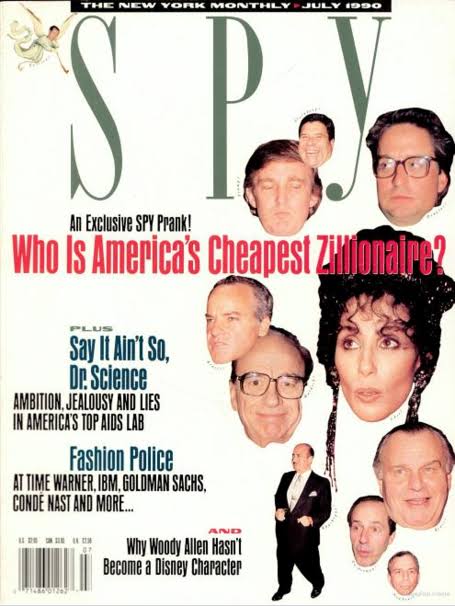 One of Spy’s best-known pranks was written up as the July 1990 cover story, “Who Is America’s Cheapest Zillionaire?” The premise was simple: the magazine sent checks for $1.11 to a series of wealthy celebrities such as Rupert Murdoch, Bill Cosby, Cher, and Adnan Khashoggi to see who would bother to deposit them. Anyone who deposited the first check received a second for a smaller amount. Anyone who deposited the second check received an even measlier third, and so on — each of the final checks being for 13 cents. (They were drawn not on Spy’s bank account but one belonging to the magazine’s imaginary friends at “The National Refund Clearinghouse.”)
Two men cashed the final checks. One of them was—but sorry, no spoilers!
Excerpt below:
Yes, it is a mark of immaturity to disrespect the value of a dollar, and while money can’t buy happiness, all the people we know tend to be happier when they have money than when they don’t. Still, who can help but look askance at the manic grab for cash that we see all around us every day, despite the nominal end of the 1980s: Ronald Reagan unembarrassedly accepting $2 million to glad-hand Japanese businessmen; Ed Koch discrediting his own nascent reputation as a pundit by shilling for the New York Post’s Second Chance Lotto; Tip O’Neill debasing himself after years of worthwhile public service by turning huckster for anyone willing to pay at least $50,000. Everybody, it seems, has his price.
But just how money-loving are America’s rich and famous? Sure, the megawealthy are forever doing unseemly things to make a buck: engineering hostile takeovers that leave companies hobbled with debt, for example, or erecting huge skyscrapers that crowd and darken already shadowy city streets, or denying their soon-to-be-ex-wives an equitable share of their assets. But do they do the stupid, simple things that we regular folk do?
Does your average swell clip supermarket coupons? Does he check the coin slot when placing a call at a pay phone? Does she pick up loose change from the street? We wondered: If Cher, Bill Cosby, Michael Douglas, Adnan Khashoggi, Shirley MacLaine, Saul Steinberg or Donald Trump happened upon a penny on Fifth Avenue, would he or she take the time to bend over and soil a finger lifting the coin from the street? Suppose it were a quarter? What if it were a buck? As much as these questions haunted us, we couldn’t figure out a way to reckon the answers. After all, we couldn’t exactly drop a couple of pennies in front of the Four Seasons and wait to see which prominent skillionaires would stop and retrieve them.
We could, however, send them checks for minuscule sums of money—sums so small they couldn’t fund as much as a minute of the recipients’ existence—and see who would bother to bank these teensy amounts of money.
So we created a company, the National Refund Clearing-house, which we fully and legally incorporated in New York State. This enabled us to open a checking account. Thus armed with a mechanism, we needed a pretext.
To that end, we drafted a cover letter.
Dear [WEALTHY PERSON’S NAME HERE],
Our records show that you were over. charged $1.l1 for services rendered in 1988 due to a computer error. Enclosed is a check to make up the difference. We apologize for any inconvenience this may have caused you.
Sincerely,
Edward Topolansky
Account Manager
That accomplis“Who Is America’s Cheapest Zillionaire?”
July 1990 — A famous Spy prank aimed to find out. You won’t believe who won.
SPY MAGAZINE
NOV 03, 2026
One of Spy’s best-known pranks was written up as the July 1990 cover story, “Who Is America’s Cheapest Zillionaire?” The premise was simple: the magazine sent checks for $1.11 to a series of wealthy celebrities such as Rupert Murdoch, Bill Cosby, Cher, and Adnan Khashoggi to see who would bother to deposit them. Anyone who deposited the first check received a second for a smaller amount. Anyone who deposited the second check received an even measlier third, and so on — each of the final checks being for 13 cents. (They were drawn not on Spy’s bank account but one belonging to the magazine’s imaginary friends at “The National Refund Clearinghouse.”)
Two men cashed the final checks. One of them was—but sorry, no spoilers!
Excerpt below. Read the entire story here.
Yes, it is a mark of immaturity to disrespect the value of a dollar, and while money can’t buy happiness, all the people we know tend to be happier when they have money than when they don’t. Still, who can help but look askance at the manic grab for cash that we see all around us every day, despite the nominal end of the 1980s: Ronald Reagan unembarrassedly accepting $2 million to glad-hand Japanese businessmen; Ed Koch discrediting his own nascent reputation as a pundit by shilling for the New York Post’s Second Chance Lotto; Tip O’Neill debasing himself after years of worthwhile public service by turning huckster for anyone willing to pay at least $50,000. Everybody, it seems, has his price.
But just how money-loving are America’s rich and famous? Sure, the megawealthy are forever doing unseemly things to make a buck: engineering hostile takeovers that leave companies hobbled with debt, for example, or erecting huge skyscrapers that crowd and darken already shadowy city streets, or denying their soon-to-be-ex-wives an equitable share of their assets. But do they do the stupid, simple things that we regular folk do?
Does your average swell clip supermarket coupons? Does he check the coin slot when placing a call at a pay phone? Does she pick up loose change from the street? We wondered: If Cher, Bill Cosby, Michael Douglas, Adnan Khashoggi, Shirley MacLaine, Saul Steinberg or Donald Trump happened upon a penny on Fifth Avenue, would he or she take the time to bend over and soil a finger lifting the coin from the street? Suppose it were a quarter? What if it were a buck? As much as these questions haunted us, we couldn’t figure out a way to reckon the answers. After all, we couldn’t exactly drop a couple of pennies in front of the Four Seasons and wait to see which prominent skillionaires would stop and retrieve them.
We could, however, send them checks for minuscule sums of money—sums so small they couldn’t fund as much as a minute of the recipients’ existence—and see who would bother to bank these teensy amounts of money.
company, the National Refund Clearing-house, which we fully and legally incorporated in New York State. This enabled us to open a checking account. That accomplished, we ordered up some suitably cheap stationery, had some suitably unimpressive National Refund Clearinghouse letterhead and checks printed – several of the actual checks are reproduced on these pages — and began giving away money to 58 well-known, well-heeled Americans.
We sent these people checks for $1.11:
Woody Allen, Richard Avedon, Candice Bergen, Leonard Bernstein, Bill Blass, Tom Brokaw, William F. Buckley, Cher, Oscar de la Renta, Philippe de Montebello, Brian DePalma, Michael Douglas, Faye Dunaway, Ahmet Ertegun, John Fairchild, Mia Farrow, Richard Gere, Bob Guccione, John Gutfreund, Halston, Harry Helmsley, Dustin Hoffman, Thomas Hoving, William Hurt, Billy Joel, Adnan Khashoggi, Henry Kissinger, John Kluge, Edward Koch, Michael Korda, Henry Kravis, William Kunstler, Ralph Lauren, Arthur Levitt, Arthur Liman, Shirley MacLaine, David Mamet, John McEnroe, Zubin Mehta, Rupert Murdoch, S. I. Newhouse, Mike Nichols, William Paley, Pete Peterson, Christopher Reeve, Steve Ross, Francesco Scavullo, Arthur Schlesinger, Martin Scorsese, Beverly Sills, Carly Simon, Liz Smith, Saul Steinberg, Arthur Ochs Sulzberger, Donald Trump, Kurt Vonnegut, Raquel Welch, Mortimer Zuckerman
Let’s see what happened.