

 3.30-31 Loose Lips reading in New York. La Guardia airport is as nice as they say it is.
3.29 Yonatan Touval in the Times: “The spycraft kind of intelligence behind the war planning and execution is extensive. Recent reporting suggests that Israeli intelligence spent years penetrating Tehran’s traffic cameras and communications networks and built what one unnamed Israeli source described to CNN as an A.I.-powered “target-production machine” capable of turning enormous volumes of visual, human and signals intelligence into precise strike coordinates. That is an extraordinary achievement of surveillance and targeting. Yet never has so much been seen, so precisely, by so many people who understand so little of what they are seeing. A system can tell you where a man is. It cannot tell you what his death will mean for a nation. Such systems are trained on behavior, not on meaning — they can track what an adversary does but not what he fears, honors, remembers or would die for. This is the recurring illusion of overequipped leaders: Because they can map the battle space, they think they understand the war. But war is never merely a technical contest. It is shaped by grievance, sacred narrative, the memory of past humiliations and the desire for revenge. Those are not atmospheric complications added to an otherwise technical enterprise. They are what the war is about. So the familiar errors appear. The war planners imagine that a regime can be decapitated into collapse, whereas external attack often does the opposite — binding a battered state more tightly to a society newly united by injury, humiliation and rage. They imagine that destroying conventional assets would settle the matter, as if legitimacy, wounded sovereignty and collective anger were secondary rather than the war’s actual terrain. Planners who took their adversary’s self-understanding seriously — rather than discounting it as propaganda — might have anticipated that an attack would not weaken the regime’s narrative but instead fulfill it. They might also have foreseen the paradox that systematic decapitation does not produce negotiators. It removes them. The military theorist Carl von Clausewitz long ago recognized the delusion of reducing war to a kind of algebra. War, as he understood it, is never merely calculation. It is saturated with passion, uncertainty and political purpose. The algebra has grown more sophisticated. But the delusion is just as dangerous today as it was in the 19th century. What this war exposes, then, is a failure not only of strategy but of literacy. Literature and history, at their most serious, train precisely the faculties these leaders lack: the capacity to grant that other minds are not transparent to us, and are governed by purposes not our own. A mind tutored by history and literature knows that actors in the grip of a sacred cause tend to mean what they say — and that bombing a founding myth is more likely to consecrate it than to dissolve it.”
 3.28 No Kings
3.28 Mary Beth Hurt dies at 79.
3.27 Trump: “I hang out with losers because it makes be feel better. “I hate guys that are very, very successful and you have to listen to their success stories. I like people that like to listen to my success.”
3.27 Matteo Wong in The Atlantic: “Even before the US started bombing Iran, the AI boom’s finances were getting shaky. Major AI companies were loading up with debt to spend hundreds of billions of dollars on data centers. Investors were worried: Tech stocks fell, private-equity firms wobbled, and an industry that had become central to the global economy was looking precarious. Then the war started. The AI boom is shockingly dependent on the stability of the Middle East. All manner of industrial and financial elements in the AI supply chain—the crude oil and liquefied natural gas needed to manufacture chips and run data centers; the helium, sulfuric acid, and other key semiconductor components—are produced in the region or flow through the Strait of Hormuz. These commodities’ prices are now rising. But the risks don’t stop there: Iran has bombed data centers in the region, calling into question the viability of a rapid, worldwide data-center build-out. And that’s not even mentioning the Saudi and Emirati money that AI firms are desperate to attract, which is now up in the air. All of this presents a number of ways the AI boom could fall apart. Should that happen, Silicon Valley would take the global economy with it. Until recently, that kind of crash felt hypothetical. Today, it feels plausible and, to some, almost inevitable.”
3.26 Derek Thompson on Substack: “Gambling is flourishing because it meets the needs of our moment: a low-trust world, where lonely young people are seeking high-risk opportunities to launch them into wealth and comfort. In such an environment, financialization might seem to be the last form of civic participation that feels honest to a large portion of the country. Voting is compromised, and polling is manipulated, and news is algorithmically curated. But a bet settles. A game ends. There is comfort in that. In an uncertain and illegible world, it doesn’t get much more certain and legible than this: You won, or you lost. A 2023 Wall Street Journal poll found that Americans are pulling away from practically every value that once defined national life—patriotism, religion, community, family. Young people care less than their parents about marriage, children, or faith. But nature, abhorring a vacuum, is filling the moral void left by retreating institutions with the market. Money has become our final virtue.”
3.26 Lydia Polgreen in the Times: “ Is Trump a freak of history or its fulfillment, an aberration or a culmination? The answer, surely, is both. But in the course of his presidency, Trump has revealed a much older malady: America’s unshakable faith in its ability to shape the world to its liking, indifferent to what others might want and supremely confident that its plan is the right one. Beyond Trump, it’s this disfiguring mentality we Americans must face. In December 1952, a Scottish scholar named Denis Brogan published a remarkable essay titled “The Illusion of American Omnipotence.” Writing as the United States was emerging as the world’s pre-eminent power, Brogan diagnosed a peculiar feature of the American mind. The United States, fueled by its myths and unswervingly certain of its vision for the world, could not see difficulty, much less defeat, as a reason to question its aims. Failure was never brought about through the strength or power of rivals. It came, instead, through blunder and betrayal. “Very many Americans, it seems to me, find it inconceivable that an American policy, announced and carried out by the American government, acting with the support of the American people, does not immediately succeed,” Brogan wrote. “If it does not, this, they feel, must be because of stupidity or treason.” An admiring but canny observer of the country, Brogan captured something essential. America, in its own imagination, could never fail; it could only be failed. In its struggle against global communism through the Cold War, the country had ample opportunity to show off the reflex. When China’s insurgent communists triumphed, Brogan wrote, it was widely understood as a result of American bungling or treachery. China, a vast and ancient civilization, was seen as something for America to win or lose. That failure helped give rise to the paranoia of McCarthyism. Korea, Vietnam and more covert disasters were further tinder to recrimination, long after the senator had gone. Failure could come only from internal betrayal, an idea that paradoxically bolstered the illusion of omnipotence.”
3.26 Axios: “The Middle East conflict wiped out what would have been a modest upgrade to global growth and a stable inflation picture. That has been replaced with a fresh warning about soaring energy costs and U.S. prices, which are projected to run far hotter than expected. What was a more manageable inflation story now looks like a pressure test for central banks that may need to raise interest rates — or hold off on further cuts — even as growth weakens. Governments already carrying huge debt loads might need to spend more to cushion the blow for households. “The energy price surge and the unpredictable nature of the evolving conflict in the Middle East will raise costs and lower demand, offsetting the tailwinds from strong technology-related investment and production, lower effective tariff rates and the momentum carried over from 2025,” the Organisation for Economic Co-operation and Development, a Paris-based research and policy group, wrote in its economic outlook released this morning. The OECD projects U.S. headline inflation will be 4.2% this year, up 1.2 percentage point from its previous projection in December. Still, the group expects those new inflation pressures to fade by the end of 2027, with U.S. inflation projected to decline to 1.6% — a rate that is actually 0.7 percentage point lower than its last forecast.”
3.25 Liam Denning on Bloomberg: “The conflict in Iran represents both an expression of US ‘energy dominance’ and a profound test of it. Resurgent domestic oil and gas production promised insulation against the fallout from a new war in the Middle East. The same war is casting doubt on that promise. This war is changing perceptions about the security of Middle Eastern fuel exports and the US may benefit from that for a while. But large importers such as China, India and the European Union may similarly balk at increased reliance on a mercurial, and prickly, US in the long term.”
3.25 Peter Martin shares this segment fromCharlie Rose. https://charlierose.com/videos/5532?autoplay=true
3.24 Tracy Kidder dies at 80.
3.24 Politico: “Jack Smith’s office sought to map a vast web of contacts between President Donald Trump’s most vocal Republican allies in Congress and key players in his bid to subvert the results of the 2020 election, according to newly released records of the Smith-led investigation. Emails from January 2023 circulated among Smith’s deputies show how top GOP lawmakers communicated directly with individuals later identified by Smith as Trump’s co-conspirators in his election interference plot, including attorneys Rudy Giuliani and John Eastman. Those contacts became the Smith office’s justification for pursuing subpoenas of phone logs for more than a dozen Republican officials. That includes former Speaker Kevin McCarthy and Sen. Lindsey Graham of South Carolina — who were previously known to be of interest to Smith’s investigators — as well as then-Rep. Lee Zeldin of New York, who is now Trump’s head of the EPA and is among other lawmakers not previously known to be under Smith’s microscope. These Republicans and others are featured in the materials released Tuesday by Senate Judiciary Chair Chuck Grassley, who has been leading a probe into Smith’s work. The Iowa Republican made the documents public to help support the party’s widely held position that Smith was politically motivated in his pursuit of criminal charges against Trump during the Biden administration — for efforts to overturn the election and his mishandling of classified documents. . . .But the newly public documents also offer a more expansive picture of who Smith’s team believed might have had information that could bolster their probe into the campaign to undermine the 2020 election results that culminated in a deadly riot. The special counsel’s office found that Rep. Brian Babin had communicated with Trump’s then-chief of staff Mark Meadows and then-Director of National Intelligence John Ratcliffe, who is now director of the CIA. A spokesperson for Ratcliffe did not immediately respond to a request for comment. Zeldin corresponded with Meadows and Rep. Scott Perry of Pennsylvania, who was a close Trump ally in the effort. Cruz had calls with Meadows, Eastman and Ratcliffe and was one of several senators who received a call from Giuliani on Jan. 6. Those contacts explain Smith’s interest in obtaining subpoenas for the phone logs for a dozen current and former Republican members of Congress, which his team said would be used to “establish logical evidentiary inferences regarding Trump and his surrogates’ actions and intent.” The list of potential subpoena targets also includes Arizona Republican Reps. Andy Biggs and Paul Gosar. ”
3.23 Katie Glueck in the Times: “In just the last few weeks, the United States plunged into a new and deeply unpopular war in the Middle East. Gas prices skyrocketed. A synagogue was attacked in Michigan, an attack that officials said was inspired by the Islamic State unfolded near Gracie Mansion in New York City, and a shooting at Old Dominion University in Virginia is being investigated as terrorism. Oh, and measles is coming back while jobs are going away. Regardless of your partisan lean, it’s safe to say that these are scary times. . . .Senator Chuck Schumer has privately taken to summarizing his party’s line of attack against Republicans as the “three Cs” — chaos, costs and corruption. Many other ambitious Democrats are spelling out what “chaos” looks like in Americans’ daily lives and reminding them of which party is in power. “Oil prices are up,” Gov. JB Pritzker wrote on social media yesterday. “Measles is back. Farms are folding. Tariffs are raising grocery costs. Illinoisans have been sent to fight another Middle East war. Trump has been an unmitigated disaster for America.” Accusing Trump of being a chaos agent, of course, is nothing new for Democrats, and that argument works only some of the time, as Joe Biden, Kamala Harris and Hillary Clinton all learned the hard way. And anyone who has lived through the last six years (remember the pandemic?) is no stranger to the feeling that the world is spinning out of control. What may be significant here, though, is whom Americans fault for their sense of insecurity. Earlier this year, some Republicans told me that scenes of violence and brutality on American streets amid ICE raids threatened to cut into both their traditional advantage on immigration and their claim to the “party of order” mantle. And a Quinnipiac University poll released this month found that 58 percent of voters disapproved of Trump’s handling of the economy — “the highest disapproval he has ever received for his handling of the economy,” according to the pollster. “Breaking news,” snarked former Mayor Rahm Emanuel “People prefer order over disorder.” He suggested that voters would gravitate toward “the goal line of security, whether that’s economic security, personal security, political security,” and the candidates or party that seem to offer the most stability. Former Representative Steve Stivers of Ohio, a former chair of the House Republican campaign arm, stressed that there was a long way to go before November — but if this election comes down to which party makes Americans feel safer, he argued, Republicans should have an advantage. “I would bet that if this election is about security, Republicans actually hold the House,” he said. “The ‘wimp’ identity is so deeply burned into Democrats’ DNA that they are incapable of making the American public feel safe.”
3.23 Mika Zibanejad plays his 1000th NHL game.
3.23 Valerie Perrine dies at 83.
3.22 Clive Crook on Bloomberg: “Global fragmentation appears to be well underway. The astonishing shift in US foreign and economic policy is a primary cause, but the picture is far from simple and implicates many other factors. How to make sense of this teeming disorder? Where will these shifting forces lead the world? . . . .Classical liberals expect economic integration, domestic political stability and cordial international relations to form a virtuous circle. Trade raises living standards; rising prosperity softens political rivalries and stifles partisan resentments; cross-border commerce creates shared interests and eases geopolitical tensions. But an equal and opposite vicious circle — a doom loop — is also possible … trade retreats, growth falters and inequality worsens.”
3.21 J.B. Prtitzker at the Gridiron Dinner: “Obviously, Democrats do have a strong, fearless leader. Fighting for affordable health care. Releasing the Epstein files. And stopping the war in Iran. Her name is … Marjorie Taylor Greene.”
3.21 Robert Mueller dies at 81. Trump on Truth Social: “Robert Mueller just died. Good, I’m glad he’s dead. He can no longer hurt innocent people!”
3.20 Chuck Norris dies at 86.
3.19 Jon Meacham at the National Constitution Center.
3.17 Axios: Nvidia’s chips are improving at such a staggering pace that it defies any historical comparison. Without these gains, physics would slam the brakes on the data center boom. It’s like going from a Model T to a Tesla in under a decade — instead of more than a century. If fuel efficiency in cars had improved as swiftly as chips, “we’d be driving to the moon and back in one gallon of gas,” said Josh Parker, head of sustainability at Nvidia.
3.16 Richard Florida in the Times: “Dubai now sits just behind New York and London and ahead of established global cities like Tokyo, Singapore, Zurich, Paris, Frankfurt, Los Angeles and Chicago in its ability to attract global white-collar talent. . . And the Dubai model is spreading. Other cities — including Riyadh, Saudi Arabia; Istanbul; Miami; and Doha, Qatar — are attempting to adopt some variation on the same basic formula to compete for the same class. But that duplication also means these cities can be replaceable. If one falters, another steps up to take its place. The elites can flit among them, because any real attachment they feel lies elsewhere. Dubai has become a gathering place for conferences and art fairs and the types of events that globally mobile people like to attend (some of which are now being canceled, postponed or moved online), but they can move elsewhere, too. This new kind of city is a sharp break with the past. For most of human history, people lived and worked in the same place, and cities grew up around that basic fact. They transform, rebuild after fires and disasters and become richer and sometimes poorer, but they draw their resilience from their rootedness, the fact that people feel they belong there. To say “I am a New Yorker” or a Londoner or “I am from Pittsburgh” or Detroit or Rome or Barcelona — that is not just a map. It conveys a deep sense of history, belonging and meaning, a personal identity, not just a transaction. Those identities are messy and unequal, but they are substantial. They are one of the primary ways people answer the basic questions of who they are and where they belong. And they are part of what brings people back to hang on and rebuild, no matter what. That kind of identity has deep roots. Long before factories or financial markets, people rooted themselves in where they lived and in the communities they built there. Place, kinship and a shared way of life were the basic materials of human identity. Marx described how industrial capitalism alienated workers from their labor, from one another, from their sense of agency. But there is a deeper form of alienation, one with a far longer history, and that has to do with the identity we draw from place, from home, from community. That source of identity is now being ripped apart.”
3.16 George Packer in the Atlantic: “What is life like for someone born in the 21st century? Your everyday reality is disorienting change—but not the kind that freed Lippmann and his generation to shape their era. Instead, your overwhelming feeling is that the game is rigged against you. You see the old as at best indifferent, if not outright predatory, and lacking the ability or the desire to solve the problems they’ve inflicted on you. The electronic air you breathe crackles with vituperation. Political and media elites hoard status and wealth by keeping you in a perpetual fever of resentment and fury. Meanwhile, tech giants addict you from toddlerhood to devices that alienate you from other people and the natural world, trapping you in a hall of mirrors, until you give up on the idea that truth is even knowable and surrender to the wildest images of unreality. Your sense of your own existence grows fragile, and your job prospects are as precarious as your mental health. Whatever your race or gender, it feels like a liability. The system is a conspiracy against your chance at a decent life. Anger and helplessness drive some young people to Nick Fuentes, others to Hasan Piker, and others still to fentanyl or 20-hour days of Fortnite. They might revile one another, but they exist in the same frame, where they suffer many of the same afflictions. From this perspective, the culture wars momentarily recede. Perhaps the most important arena of struggle isn’t the internet, where the wars are fought and nothing is achieved except division, but the physical world, where certain problems are common to all ordinary people. Perhaps the deepest conflict is not between red and blue, but between power and powerlessness. Compared with a vicious online duel, this conflict is hard to dramatize. It seldom becomes the focus of politics, except in grand rhetorical gestures or small fixes for the deterioration of everyday life. A congresswoman denounces monopolistic oligarchy; a senator rails against Big Tech; another congresswoman drafts legislation against the nuisance of overly bright headlights and for the “right to repair” your own truck or washing machine. A movement of 20-somethings embraces dumb phones. And even now, amid the head-spinning events of Trump’s second term, there’s a sense that nothing fundamental changes. In [Walter] Lippmann’s time, the relations among citizens, corporations, and government underwent a historic transformation; in our time, new laws and civic reforms hardly ever arise. We spend our energy on the mostly online battles of the red-blue war, stumbling down the path of the 1850s, while the powerful entities that control our lives grow bigger and more corrupt.”
3.15 Len Deighton dies at 97.
3.14 Pete Hegseth: “The only thing prohibiting transit in [Hormuz] right now is Iran shooting at shipping. It is open for transit should Iran not do that.”

 3.14 With the grandkids at the animal sanctuary
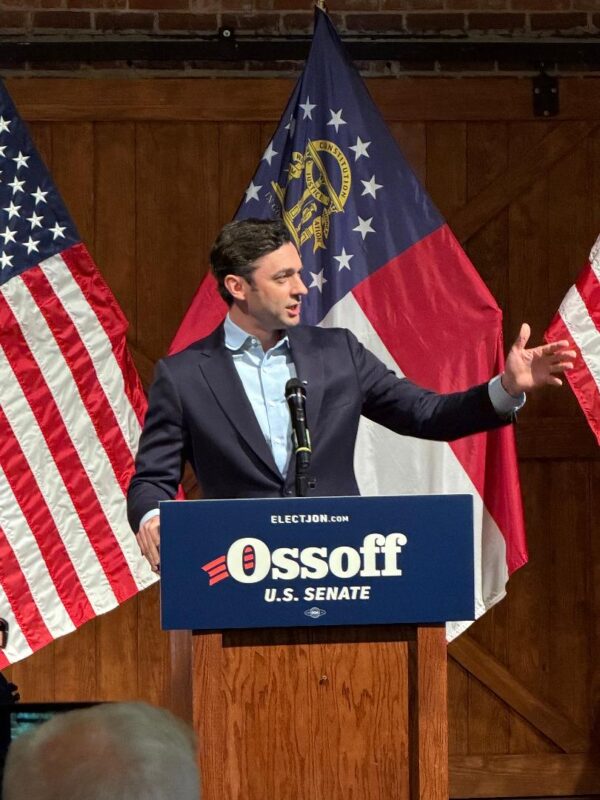
3.13 Sen. Jon Ossoff in Tyrone.
3.13 Military historian and strategic studies expert Phillips O’Brien, in conversation with Paul Krugman: “I really think Trump believed he would’ve had a few days of air raids, decapitate the government, and that would be it. I just don’t think it entered their mind, and because no one stands up to him. Supposedly, there were some military warnings, people saying, ‘the Iranians might fight back and you have to have preparations in case they do. But he seemed to not take those on. And these are people who wear shoes that are too big for them to make him happy. That story about Marco Rubio, that picture reveals a great deal about where we are. I don’t know how he kept them on, but he did and he was humiliated, because Trump gave him those shoes. If that is the culture you create around you, you’re gonna make really bad decisions. You know what I thought? I actually thought, and I’m not saying Trump is Stalin but it’s very much the culture Stalin had around him where he humiliated everyone around him by making them look and be faintly ridiculous. That was actually something he did deliberately. And what happened, of course, is that all they would do is reinforce all his prejudices. And that’s why you end up with Stalin saying, “Oh, Hitler’s not gonna attack me in June, 1941. Never! Not gonna happen!” And everyone around him going, “Of course Joseph, of course they won’t do that.” And that’s where we are. We basically have a Stalin-like court around Trump and we see the decisions that such a court makes.”

 3.13 John F. Burns dies at 81.
3.10 Alexander Butterfield dies at 99.
3.8 Fayetteville (left)
3.8 Country Joe McDonald dies at 84.
3.7 Atlanta tour
 3.7 Outside Gracie Mansion, NYPD Assistant Chief Aaron Edwards leaps a barrier to chase down one of two allegedly ISIS-inspired bombing suspects.
3.5 Trump on X: “The current Secretary, Kristi Noem, who has served us well, and has had numerous and spectacular results (especially on the Border!), will be moving to be Special Envoy for The Shield of the Americas.” Noem will be replaced by Sen. Markwayne Mullin.
3.4 Ronnie Eldridge dies at 92.
3.4 Lou Holtz dies at 89.
3.3 Axios: “Secretary of State Marco Rubio effectively blamed Israel for drawing the U.S. into war with Iran. Rubio’s remarks were the first time a Trump official had so explicitly acknowledged Israel as a driving force behind the war — landing at a moment when Americans’ public support for Israel has hit historic lows. “We knew that there was going to be an Israeli action” against Iran, Rubio told reporters. “We knew that that would precipitate an attack against American forces” by the Iranian regime. “And we knew that if we didn’t preemptively go after them before they launched those attacks, we would suffer higher casualties … And then we would all be here answering questions about why we knew that and didn’t act.” Rubio added later: “Obviously, we were aware of Israeli intentions and understood what that would mean for us, and we had to be prepared to act as a result of it. But this had to happen no matter what.” . . .The big picture: Rubio’s remarks were widely interpreted as making the U.S. look subordinate to Israel’s interests. And they inflamed already angry MAGA elites who had spent the day railing against President Trump’s decision to go to war.”
3.2 Greg Carlstrom on X: “Trump is basically calling up every journalist in his phone to workshop different timelines and goals for his war. In the past two days:
: the aim is “freedom for the people” of Iran
: maybe we can “end it in two or three days” with a deal
: might be “four to five weeks”, I have “three very good choices” who might take control in Iran
: actually, nevermind, we killed those choices He doesn’t sound convinced by any of it. He’s throwing spaghetti at the wall. Ultimately I suspect he just wants to say he “solved” a problem that has vexed every American president since Jimmy Carter. But there’s no clear idea what that looks like and no plan for how to get there. And there are plenty of possible scenarios in which Trump declares victory and leaves the region with an absolute mess.”
3.2 Pete Hegseth: “This is not a so-called regime-change war, but the regime sure did change.”
3.2 George Will in the Washington Post: “The wielders of Iran’s regime, which is founded on fear, surely experienced a sudden, terrifying epiphany when the aerial attacks, unlike previous ones, began in daylight: The attackers knew when and where the regime’s senior officials would be meeting in Tehran that day. Precision munitions, directed by spectacular intelligence, enabled a decapitation strategy. The at least 30,000 protesters who perished in Iran’s streets in early January did not die in vain.”
3.2 Robert Frost: “The best way out is always through.”