
2.28 US and Israel launch massive bombing attack on Iran, killing decades-long Supreme Leader Ayatollah Ali Khamenei. Eliot Cohen in The Atlantic: “Any normal president launching a war with such aims against a country of some 90 million people; with an area roughly that of France, Germany, Spain, and Italy combined; with a GDP (in nominal terms) of $400 billion; and that has close relationships with Russia and China would probably have doffed the baseball cap, put on a tie, and delivered a somber speech from behind the Resolute Desk in the Oval Office. More important, a serious president would have prepared over months the ground for such a war—including by discussing the Iranian challenge at length during the State of the Union. He would have tried to explain to the American people why this, rather than their economic problems, was a matter of top urgency. He would have avoided unnecessarily antagonizing, let alone mocking and baiting, the opposition party, which is likely to control at least one house of Congress after the midterms. He would have worked on unifying support within his own base, which is internally divided among isolationists, Israel haters (who will react badly to this), and old-line Republicans who are queasy about wars launched without congressional sanction. Trump did none of these things. . . . .How will the war unfold? Conceivably, it could work. The air attacks are probably coordinated with more sophisticated clandestine and special operations by both the U.S. and Israel. Perhaps an opportunity will indeed open up for the regime’s overthrow, either by a mass revolt or a coup by a hitherto-unknown insider or military figure willing to break with the regime’s past. Or not. The regime has planned for this kind of event and, deeply unpopular though it is, has millions of adherents who are either complicit in its crimes or beneficiaries of its largesse. They, not the masses, are the ones with the guns. Trump has created a substantial moral hazard for the United States of a kind not seen since the Hungarian Revolution, in 1956. By encouraging the Iranian people to rise up against a regime that was willing to openly massacre them in the thousands or tens of thousands, it has incurred a profound obligation to see them through this. If such uprisings are attempted and fail, the blood guilt will be American, incurring even more damage to America’s credibility, reputation, and honor than has already been suffered.”
2.27 Neil Sedaka dies at 86.
 2.26 Buzzard
2.24 Trump delivers State of the Union address, speaking for a record 108 minutes.
2.22 Jack Hughes, bloodied and with lost teeth after a third-period high stick, scored in overtime to give the United States Men’s Ice Hockey team a 2-1 victory over Canada to win the Olympic gold medal. Canada had the better of the play in the tight game, but goalie Connor Hellebuyck produced a 41 save masterpiece to keep the US in the game.
2.21 Bill Mazeroski dies at 89.
2.20 Trump responds to the Court: “I’m ashamed of certain members of the court, absolutely ashamed for not having the courage to do what’s right for our country. . . .They’re just being fools and lap dogs. They’re very unpatriotic and disloyal to our Constitution. It’s my opinion that the court has been swayed by foreign interests and a political movement that is far smaller than people would ever think.” “I think that foreign interests are represented by people that I believe have undue influence, have a lot of influence, over the Supreme Court,” he said without offering evidence. “Whether it’s through fear or respect or friendships, I don’t know, but I know some of the people that were involved on the other side, and I don’t like them. I think they’re real slimeballs.” Later, of Justices Gorsuch and Barrett, he said, “I think it’s an embarrassment to their families, the two of them.” Trump said he had tried mightily not to offend the justices before the ruling. “I wanted to be very well behaved, because I didn’t want to do anything that would affect the decision of the court. Because I understand the court. I understand how they’re very easily swayed. I want to be a good boy.”
2.20 Tim Stanley in The Washington Post: “Mountbatten-Windsor embodies a monarchy that is reduced in stature in a country that is itself getting poorer and crasser, and has inherited a set of institutions — Crown, a state church, House of Lords — the purpose of which it can’t recall. If we’re not careful, if their reputation sinks any lower, we might finally join the U.S. and wipe them away in a fit of revolutionary disgust. This would be a terrible mistake. Is America any more democratic, or its elites any more accountable, for being a republic? The ex-prince perhaps faces jail for his connection to  Epstein; U.S. presidents, intellectuals and billionaires do not. Post-Elizabethan Britain has no illusions about its rulers and, regarding its elite as a soap opera, feels zero embarrassment at arresting its aristocrats.”
2.19 Alysa Liu, “bursting with joy,” wins gold in Olympic figure skating. She becomes the first American woman to win a figure skating medal since 2006, and the first to win gold since Sarah Hughes at the Salt Lake City Games in 2002.
2.19 The US Women’s Olympic hockey team wins the gold medal, defeating Canada 2-1 in overtime. After Hillary Knight tied the game in the final two minutes of regulation, Megan Keller scores the golden goal.
 2.19 British police arrest Andrew Mountbatten-Windsor on suspicion of misconduct in public office related to the Epstein files. It was the first time in modern history, since the arrest of Charles I in 1649, that a member of the British royal family had been arrested.
2.17 Jesse Jackson dies at 84.
2.16 Robert Duvall dies at 95.
2.15 Toby Harshaw on Bloomberg: “There is this bit of insanity, via the New York Times: “President Trump on Thursday announced he was erasing the scientific finding that climate change endangers human health and the environment, ending the federal government’s legal authority to control the pollution that is dangerously heating the planet.” Welp, that was easy. The only surprise is that it took so long. I mostly understand the political divide in Washington here: Coal and oil and gas companies overwhelming support Republican candidates. (Increasingly, so do renewable energy companies, because the public trough runs along both sides of the aisle.) The partisan divide outside the capital is less straightforward: There is a serious body of evidence showing that MAGA followers are net losers in kneecapping clean energy. So what might make those EverTrumpers look more closely at the facts? Their insurance premiums, natch. “Insurance companies live in a parallel universe where greenhouse gases are heating the atmosphere and intensifying natural disasters, harming human health, destroying property and raising insurance costs,” writes Mark Gongloff. “The US government’s universe is an increasingly lonely fantasy world. You’re trapped in the real one.”
2.14 Aaron Reinchlin-Melnick, immigration expert, in conversation with William Kristol: “The US government wants to arrest, detain and deport one in every 24 people in the country—4% of the US population. In some cities, in some neighborhoods, it’s as high as one in 10 people. In some, it’s probably even higher than that—maybe one in three in some neighborhoods. That cannot be done without fundamentally transforming who we are as a people and our relationship to law enforcement, because as you said, these are not people who are distinct and separate and apart from the community—they are part of it. Again, about eight and a half to nine million have been here for 15-plus years. There’s about six million mixed-status families in the United States, where you’ve got an undocumented immigrant with a US citizen parent or child or spouse. And of course, undocumented immigrants work at businesses with American citizens; they hire American citizens in some circumstances. Some of them are employers—they start small businesses. They rent commercial property, they go to church, they bring their kids to school, they participate in the community. And when they are deported, the community notices and is impacted. Small towns are going to lose everyone who works at a factory, for example, following raids—and that may lead to a factory closing; that may lead to small businesses in that town closing; and all of that impacts the broader economy. . . .All of this is going to continue to ramp up, because the Trump administration shows no sign of pulling back. I mentioned at the start: these warehouses that are going up—the Trump administration wants to build, as Todd Lyons, acting director of ICE, said, “Amazon Prime, but for human beings.” They want a industrialized, modernized system of mass detention and deportation—where rather than using a patchwork of local facilities around the country, they just buy a bunch of commercial warehouses; throw up some cots on the inside, some internal barriers and some rudimentary services; and say, “These are our new detention centers—8,000 people, 8,500 people, 9,000 people in this converted commercial warehouse—because that’s the easiest way for us to carry out these campaigns,” and that’s something you can’t go back from. . . .For the last 50 years of the United States’ efforts to combat undocumented immigration, the focus has been the border. The majority of the resources, the manpower and everything, went to the border. It went to border patrol agents; it went to the border wall; it went to detention primarily of migrants. Immigration detention as we know it today started because of Haitian migrants in the early 1980s—not because of any effort to arrest people in the interior. And all of those resources have been designed at keeping people out, but far fewer resources have gone to this idea of: what are we going to do about the undocumented population that’s here already?. . . Now all of a sudden, you have an administration coming in and saying, “We’re going to actually do this thing.” And you have Congress saying, “Here’s an unheard of, unprecedented sum of money for you to actually carry this thing out.” . . . The detention system [has] expanded by about a little bit over 80%—so going from 40,000 people when Trump took office to about 73,000 peak in mid-January. . . . They will be ramping up even more in 2026—as they have thousands of new officers coming online thanks to the One Big Beautiful Bill Act funding, plus an even greater ramp up in detention capacity and enforcement capability around the country….By the end of the year potentially around 16,000 detention officers—and those are the basic immigration enforcement officers—plus the 6,500 or so ICE Homeland Security investigations officers, thousands of whom have been redirected away from criminal law enforcement towards immigration enforcement. Which may mean that they have around 20,000 or more people whose job it is going to be going out on the streets, arresting people, picking people up at jails and detention centers, staffing detention centers, and doing the business of mass deportation. . . . .What the Trump administration has been doing over the last eight to ten months is finding ways to shortcut the removal process—to eliminate whatever due process protections and internal barriers there are in between the removal process or the arrest and the removal process—so that they can increase the deportation throughput. And that has looked like a lot of tactics and legal maneuvers that we’ve never really seen before: courthouse arrests; mass ICE check-in arrests; a sort of blanket policy. . . It’s not just immigration. . . the government has been transformed into an arm of the Trump id, with the idea that there is no resistance.”
2.13 Axios: “Even if inflation pressures have eased in recent months, the high price levels frustrating consumers are evident if you consider how much prices have gone up over the past year. That’s where some tariff-related price hikes are evident, even if it doesn’t seep into headline CPI: Beef prices declined 0.9% last month, but they are still up a whopping 15% compared with a year ago. Roasted coffee gained just 0.1% last month, but costs are up 17% from last January.”
2.13 Fareed Zakaria in the Washington Post: “Politics runs in cycles. The appetite for rupture may fade once its costs become clear. But for now, in countries as different as Britain and Japan, the mood is unmistakable. In an age of anxiety, voters prefer rebellion to restoration. As the Democrats look forward to the midterms, they should keep this in mind.”
2.12 Robert Draper in the Times: “Journalists and researchers will spend the next months ferreting through the Epstein files in search of further criminal conduct or a new conspiratorial wrinkle. But one truth has already emerged. In unsparing detail, the documents lay bare the once-furtive activities of an unaccountable elite, largely made up of rich and powerful men from business, politics, academia and show business. The pages tell a story of a heinous criminal given a free ride by the ruling class in which he dwelled, all because he had things to offer them: money, connections, sumptuous dinner parties, a private plane, a secluded island and, in some cases, sex. That story of impunity is all the more outrageous now in the midst of rising populist anger and ever-growing inequality. The Caligula-like antics of Jeffrey Epstein and friends occurred over two decades that saw the decline of America’s manufacturing sector and the subprime mortgage crisis, in which millions of Americans lost their homes. If Mr. Epstein’s goal was to build a wall of protection around his abuse by surrounding himself with the well connected, he failed in the end. But both before and after he was first prosecuted for abusing girls, his correspondence described a network of people whose high-flying lives belied the struggles of ordinary Americans. And at the center of that network was a sexual predator seemingly on top of the world. “We’ve heard so much about the Epstein scandal over the past several years,” said Nicole Hemmer, a history professor at Vanderbilt University who writes frequently about political culture. “And yet people do seem shocked by the scope of elite complicity in his world. It’s a level of corruption that the public is now getting a full view of.”
2.12 Axios: Forget K-shaped, try gray-shaped: Older Americans are powering the economy. The changing demographics in the U.S. — more old people, fewer young ones — are reshaping jobs and spending in all kinds of ways. Nearly all of the job growth in January came from the health care and social assistance sectors, per the BLS data out yesterday. Health care employment also drove much of the labor market growth last year. The big picture:The senior population is getting bigger as a share of the overall population. They’re also getting richer. “From higher home prices and, more recently, surging stock prices [older Americans] are driving the train, there’s no doubt about it,” says Mark Zandi, chief economist at Moody’s Analytics. About 30% of Americans were age 55 and older in 2024 — two decades ago, they made up less than one-quarter of the population. More than 70% of all the wealth in the country is held by people over 55, per Federal Reserve data. They’re spending a lot of money. More than 45% of consumer spending now comes from those age 55 and older — up from less than 40% in 2020, per federal data crunched by Moody’s Analytics.
2.12 Paul Krugman: “So while people inside the MAGA bubble keep insisting that Trump is a great president, the greatest president ever, presidenting like nobody has ever seen before, their cheerleading reeks of desperation. The MAGA implosion is gathering force. Americans are mad as hell, and they won’t be gaslit anymore.”
2.12 David A. Graham in The Atlantic: “Trump’s initial argument about the situation in Minnesota was that it was so dire, it required uniquely forceful action. Yet he’s now ready to pull back without achieving any of the goals he laid out. For another president, sending the agents home could be an acknowledgment of rethinking that calculus or reckoning with mistakes made. But that’s not how Trump has framed the decision. “We’re pulling out because we’ve done a great job there,” Trump told NBC News last week, going on to insult Minnesota’s governor and Minneapolis’s mayor. This fits into a pattern of his second term. The president announces a big push; it fails to achieve its goals and is roundly rejected by the people he claims it will benefit; he gives up in a huff. Trump’s mantra is You can’t fire me—I quit!”
2.12 Steve Schmidt on X: “Pam Bondi is a disgrace. Her performance and toxic theatrics did not leave a mark on a single member of Congress, but it will be the defining moment of her life.”
2.11 Paul Krugman: “While MAGA-world’s fantasy villains like George Soros are brilliant and subtle, MAGA’s real villains are uncouth and dim-witted. Yet they carry out their sinister schemes in broad daylight. For all they need to flourish is utter shamelessness, along with the backing of a corrupt administration and a corrupt political party. So it’s worth remembering Hannah Arendt’s observations about the architects of Hitler’s genocide, which led her to coin the phrase “the banality of evil”. As Arendt noted, the horrors of Nazism were not inflicted by brilliant geniuses, but through the normalization of thoughtless, amoral behavior that eventually turned into evil. Thus while Lutnick appears on the surface like a dim-witted backroom grifter, he is a warning of something far more sinister and malign lurking below.”
2.11 Jimmy Kimmel on ABC: “She’s shouting like a crazed dance mom, berating democrats for giving her chubby daughter a low score. . . .There is nothing to defend here. This Department of Justice is hiding the names of people who are not victims. Why are they doing that? If they have nothing to hide, why are they hiding names? That’s it. That’s the only question anybody needs to ask.”
2.11 Dahlia Lithwick in Slate: “Pam Bondi may be in charge of many officials and many investigations and many legal things at the DOJ, but what she is protecting is neither justice nor law.”
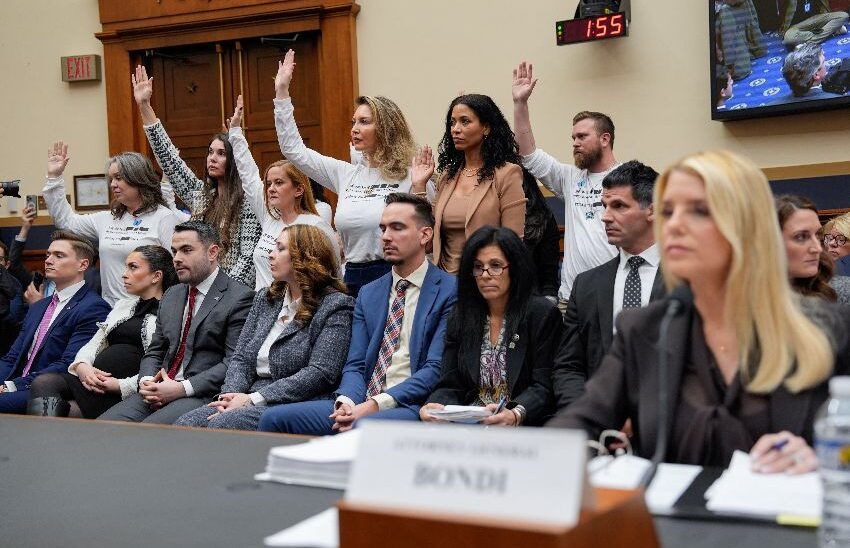 2.11 In heated testimony before the House of Representatives Judiciary Committee, Attorney General Pam Bondi defends the justice department’s handling of the Jeffrey Epstein files. After Rep. Pramila Jayapal revealed that none of the Epstein survivors in the room had yet been interviewed by the Justice Department, she called on Bondi to apologize. Although the women were standing right behind her, Bondi neither acknowledged the women, nor apologized, describing Jayapal’s questioning as “theatrics” and adding: “I’m not going to get in the gutter with this woman.” Bondi also called Rep. Jamie Raskin “a washed-up loser lawyer,” referred to Rep. Thomas Massie as “a failed politician” and accused Jewish House member Becca Balint, who lost her grandfather in
 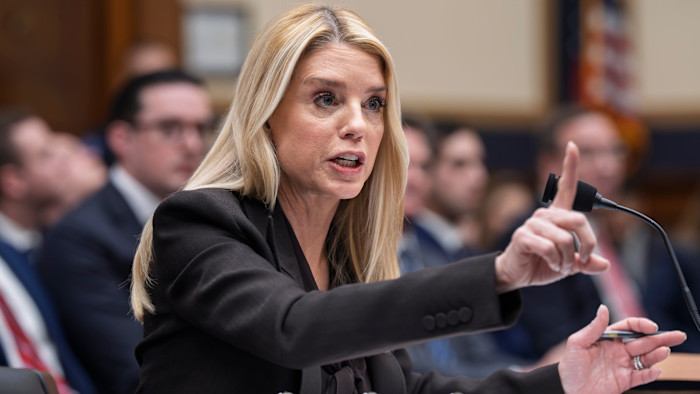 the Holocaust, of being antisemitic. “During the impeachment, you said the president conspired, sought foreign interference in the 2016 election. Robert Mueller found no evidence — none!–of foreign interference in 2016. Have you apologized to President Trump, all of you who participated in those proceedings? You all should be apologizing. You sit here and attack the president. I’m not going to have it, I’m not going to put up with it. You know, all they want to do –the American people need to know this–they are talking about Epstein today. This has been around since the Obama administration. This administration has released over three million pages of documents, and Donald Trump signed that law. He is the msot transparent president in the nation’s history. And none of them asked Merrick Garland over the last four years one word about Jeffrey Epstein. How ironic is that? You know why? Because Donald Trump –the Dow! The Dow right now is over 50,000 dollars. I don’t know why you’re laughing [pointing to Jerry Nadler]. You’re a great stock trader, as I hear, Raskin! The Dow is over 50,000 right now! The S&P is almost 7,000, and the NASDAQ’s smashing records.”
2.11 Conor Friedersdorf in The Atlantic: “In The Authoritarian Dynamic, the social psychologist Karen Stenner explains how people with a latent predisposition to authoritarianism get triggered, and how best to respond to preserve a pluralistic society. Her work suggests that liberals should stop framing immigration as a celebration of multicultural difference and instead emphasize ways in which immigrants are just like the rest of us: people who seek safety, opportunity, and a better future for their family. These framings can better assuage the fears of those with xenophobic tendencies, she argues. Stenner suggests that countries implement practical assimilationist policies, such as encouraging and assisting with English fluency. She argues that immigration is most sustainable—and backlash against it least likely to succeed—when inflows of new immigrants are controlled, and subject to known limits rather than unlimited in a way that feels unpredictable. As she puts it in her book, insisting on unconstrained diversity “pushes those by nature least equipped to live comfortably in a liberal democracy not to the limits of their tolerance, but to their intolerant extremes.” And once a society’s authoritarians are activated, the outcome depends in part on how its conservatives react. If they side with authoritarians, repressive policies follow. But under the right conditions, conservatives can be counted on to rally behind pluralism and tolerance. One condition is that they feel reassured “regarding established brakes on the pace of change, and the settled rules of the game,” Stenner writes.”
2.11 According to the Major Cities Chiefs Association, violent crime plunged across America’s biggest cities in 2025. If these staggering drops in major cities are reflected in broader national figures that’ll come later, the U.S. homicide rate in 2025 would be the lowest observed since at least 1900. Experts say a complex tangle of technological and social factors has curtailed homicides since the surge during COVID. Research credits “policing strategies and incarceration rates” and very long-term trends that include “mental health treatment and gun laws, the beautification of vacant lots and the phasing out of lead, which impairs brain development, from gasoline in the 1970s. Improvements in life-saving medical care have also reduced the homicide rate. The big picture: Cities report that homicides overall fell 19%; Robberies dropped about 20%; Aggravated assaults were down nearly 10%.
2.10 Matt Shumer on X: “The experience that tech workers have had over the past year, of watching AI go from “helpful tool” to “does my job better than I do”, is the experience everyone else is about to have. Law, finance, medicine, accounting, consulting, writing, design, analysis, customer service. Not in ten years. The people building these systems say one to five years. Some say less. And given what I’ve seen in just the last couple of months, I think “less” is more likely. . . . If you tried ChatGPT in 2023 or early 2024 and thought “this makes stuff up” or “this isn’t that impressive”, you were right. Those early versions were genuinely limited. They hallucinated. They confidently said things that were nonsense. That was two years ago. In AI time, that is ancient history. The models available today are unrecognizable from what existed even six months ago. The debate about whether AI is “really getting better” or “hitting a wall” — which has been going on for over a year — is over. It’s done. Anyone still making that argument either hasn’t used the current models, has an incentive to downplay what’s happening, or is evaluating based on an experience from 2024 that is no longer relevant. I don’t say that to be dismissive. I say it because the gap between public perception and current reality is now enormous, and that gap is dangerous… because it’s preventing people from preparing.”

 2.5-2.11 To Pittsburgh and back
2.9 Trump on Truth Social: “Prime Minister Carney wants to make a deal with China − which will eat Canada alive. We’ll just get the leftovers! I don’t think so. The first thing China will do is terminate ALL Ice Hockey being played in Canada, and permanently eliminate The Stanley Cup.”
2.8 In a tightly-played Super Bowl dominated by defense (or, boring), the Seattle Seahawks defeated the New England Patriots 29-13.
2.6 On Truth Social, Trump uploaded a clip that included a two second segment that depicted Barack and Michelle Obama as apes.
2.6 The Dow hits a record 50,115.67.

 2.6 Sonny Jurgensen dies at 91.
2.5 Scott Bessent on how the Senate can restore consumer confidence: “[Tell] consumers to turn off MSNBC.”
2.4 Mickey Lolich dies at 85.
2.3 The Adventures of Huckleberry Finn, by Mark Twain.
2.3 Jim VandeHei and Mike Allen in Axios: “You can only fully understand politics, business and your own anxiety in 2026 by reckoning with the three, once-in-a-generation shifts unfolding at once: The ideologies, tactics and tone of governance; The lightning-fast advancements in AI; and The overnight transformation of how our realities are shaped. All three are hitting all of us — and all at once. If you focus on only one (like many do with President Trump), you miss the enormity of change pushing our minds and nation somewhere new, different and uncertain. Once you see it, you can’t unsee it. It helps explain your anxiety, your visceral sense that work and business are evolving, and your confusion about politics and policies. And then you can do something about it. The shifting tectonic plates:
1. A once-in-a-century shift in politics and governance. Trump reinvented the Republican Party … then American politics … then American governance. He has proudly turned Republicans into an America First movement and stretched the powers of the presidency to unprecedented lengths. His actions — and the reactions to him — are reshaping what the parties believe in, who votes for them, the language and platforms our politicians use, the relevance of institutions and outside experts, and the way other nations view us. The politics and norms of one short decade ago are unrecognizable today. Democrats, especially California Gov. Gavin Newsom, are adopting many of Trump’s most pugnacious tactics. And Democrats are as likely to counter with socialism as they are with more conventional liberalism. Whatever politics was before, it won’t be again, absent a massive reset. 2. A once-in-a-generation shift in how our realities are formed. Stop thinking about news as a way to understand the world. That’s no longer how your reality, and what’s left of our shared reality, forms. We call this the “post-news era.” We’re breaking into hundreds or thousands of information bubbles, shaped and hardened based on our age, politics, jobs and interests. You’ll often find that most get their information from platforms the others never visit, and trust people the others have never heard of. The common window we once collectively looked through has splintered into countless pieces. In its place: podcasters, YouTubers, Substackers, and digital and encrypted communities. With attention scattered and trust shattered, we’ve grown highly susceptible to manipulation, polarization and frustration. A once-in-a-generation technology shift. AI has the promise, and high likelihood, of upending society at a scale greater than the internet — and possibly as profoundly as fire or electricity. Anthropic CEO Dario Amodei warns it could destroy half of all entry-level white-collar jobs in a few short years, and has a 25% chance of essentially wiping out human existence. At the same time, there’s nothing on the American or global landscape with more promise to cure disease, extend life, stretch our economy and enrich our imaginations. We’ve no choice but to get this right, and government is mostly on the sidelines.