
4.30 The Road to Ithaca, by Ben Pastor.
4.29 The Supreme Court weakens the Voting Rights Act of 1965, limiting protections against racial gerrymandering and making it harder to challenge discriminatory voting maps.
4.29 Ashley Parker and Michael Schererin The Atlantic: “Hegel’s theory of “world-historical individuals,” men who redirected the course of humanity, focused on three figures: Alexander the Great, Julius Caesar, and Napoleon Bonaparte. Hegel described them as unlikely “heroes of an Epoch” for upending established orders that had previously seemed fixed. They were “practical, political men” who were each condemned in their age for smashing norms and for other conduct “obnoxious to moral reprehension”—as Trump has been accused of, centuries later. And though Trump has long compared himself to America’s two greatest presidents, we were recently told by two people who are in a position to know such things—a senior administration official and a longtime Trump confidant—that the president had, in private conversations, begun thinking about himself less as a peer of George Washington and Abraham Lincoln, and more as an addition to Hegel’s immortal trifecta. “He’s been talking recently about how he is the most powerful person to ever live,” the confidant told us. “He wants to be remembered as the one who did things that other people couldn’t do, because of his sheer power and force of will.” The tendency to self-aggrandize is as fundamental a feature of Trump as his sculpted hair and overlong red ties. But it has become even more important in setting his priorities and steering his actions as he hurtles through his final term in office. He no longer has to worry about the judgment of voters and can instead focus on what he’s decided really matters: ascending to become one of history’s so-called great men and leaving an enduring—and, in many cases, physical—imprint. The result, at least so far, has cost many lives and billions of dollars, damaged the world economy, strained already fragile alliances, and cratered the president’s standing with the public. But those around him cast his new focus as a liberation. “He is unburdened by political concerns and is able to do what is truly right rather than what is in his best political interests,” the administration official told us. “Hence the decision to strike Iran.”
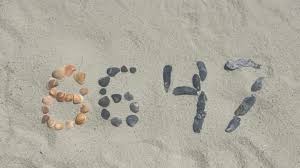 4.28 A federal grand jury returns an indictment charging former FBI director James Comey with making threats to harm President Trump by posting a photo of seashells arranged to read `86 47′ that he came up on a beach/
4.28 King Charles addresses Congress.
4.26 In an interview with Trump on 60 Minutes, Norah O’Donnell read portions of a document written by alleged gunman Cole Allen that alluded to concerns over a rapist and a pedophile. When she asked for Trump’s reaction, he said “Well, I was waiting for you to read that because I knew you would because you’re horrible people. Horrible people. Yeah, he did write that. I’m not a rapist. I didn’t rape anybody.” When O’Donnell repsonded by asking “Do you think he was referring to you?”, Trump said “I’m not a pedophile. You read that crap from some sick person? I got associated with…stuff that has nothing to do with me. I was totally exonerated. Your friends on the other side of the plate are the ones that were involved with, let’s say, Epstein or other things. But I said to myself, ‘You know, I’ll do this interview and they’ll probably…’ I read the manifesto. You know, he’s a sick person. But you should be ashamed of yourself reading that because I’m not any of those things. . . . You’re a disgrace. But go ahead. Let’s finish the interview.”
4.26 Cole Tomas Allen, 31, of Torrence, California, is charged with attempting to assassinate the president.
 4.26 Gunman attempts to storm the White House Correspondents Dinner
4.25 At the Atlanta History Center with Logan and Ivy.
4.25 Axios: “Trump is governing like a man who will never face voters again, mortgaging his party’s future on promises he won’t be around to keep. Trump’s approval has plunged to a second-term low. His signature bets — tariffs, the war in Iran, redistricting — are curdling into long-term liabilities the GOP could carry long past November. Fox News’ latest poll shows Democrats leading Republicans by 4 percentage points on the economy — the first time the GOP has trailed on its strongest issue since 2010. The war in Iran has done deep, potentially long-lasting damage to the Republican Party. Tucker Carlson — who issued an extraordinary apology this week for his yearslong Trump advocacy — is no threat to vote blue, nor are Marjorie Taylor Greene, Alex Jones or other newfound MAGA dissidents. But the anti-war realignment they represent — the young voters, the Joe Rogan listeners, the “no forever wars” coalition that delivered Trump his 2024 win — is in tatters. As gas prices surge to more than $4 a gallon, Trump said Thursday that Americans should expect to pay more “for a little while” in exchange for a nuclear-free Iran. A new Reuters/Ipsos poll found 78% of voters say gas prices are a “very big concern” for them; 77% blame Trump. Trump’s economic standing was already collapsing before the Iran war, with voters souring on his tariff agenda amid a broader affordability crisis.”
4.23 Walt Krolczyk dies at 74.
4.23 Royal Bank of Canada: “The stage is set for a cruel summer.”
4.20 Tucker Carlson says he will long be “tormented” by his role helping Donald Trump return to the White House. “It’s not enough to say, well, I changed my mind — or like, oh, this is bad, I’m out. . . It’s a moment to wrestle with our own consciences. We’ll be tormented by it for a long time. I will be. And I want to say I’m sorry for misleading people.”
4.20 Noah Hawley in The Atlantic: “Bezos and two of the world’s other richest men—Mark Zuckerberg and Elon Musk—have clearly left the world of consequences behind. They float in a sensory-deprivation tank the size of the planet, in which their actions are only ever judged by themselves. The closer I’ve gotten to the world of wealth, the more I understand that being truly rich doesn’t mean amassing enough money to afford superyachts, private jets, or a million acres of land. It means that everything becomes effectively free. Any asset can be acquired but nothing can ever be lost, because for soon-to-be trillionaires, no level of loss could significantly change their global standing or personal power. For them, the word failure has ceased to mean anything. This sense of invulnerability has deep psychological ramifications. If everything is free and nothing matters, then the world and other people exist only to be acted upon, if they are acknowledged at all. This is different from classic narcissism, in which a grandiose but fragile self-image can mask deep insecurity. What I’m talking about is a self-definition in which the individual grows to the size of the universe, and the universe vanishes. Asked recently if there is any check on his power, President Trump—himself a billionaire, and by far the richest president in American history—said, “Yeah, there is one thing. My own morality. My own mind. It’s the only thing that can stop me.” Not domestic or international law, not the will of the voters, not God or the centuries-old morality of civic and religious life. Decades of research in developmental psychology have shown that moral reasoning develops through consequences—not punishment, necessarily, but experiencing the effects of your actions on others, receiving honest feedback, having to accommodate reality as it actually is rather than as you wish it to be. It’s not that the wealthy become evil; it’s that their environment stops teaching them the things that nonwealthy people learn by living in a world that pushes back. When you can buy your way out of any mistake, when you can fire anyone who disagrees with you, when your social circle consists entirely of people who need something from you, the basic mechanism by which humans learn that other people are real goes dark. When Peter Thiel said, “I no longer believe that freedom and democracy are compatible,” he wasn’t talking about your freedom. He was talking about his own. You don’t exist. When Musk took a chainsaw to the federal government as part of the inside joke he called DOGE, he did so with the air of a man who believed that nothing matters—poverty, chaos, human suffering. He was having fun. It didn’t even matter that the entire destructive exercise ultimately yielded no practical financial gains. For him, the outcome was a foregone conclusion: He could only win, because losing had lost its meaning.”
4.20 Tim Cook steps down as CEO of Apple, to be replaced by John Ternus, the company’s head of hardware engineering.
4.20 Labor Secretary Lori Chavez-DeRemer leaves post amid allegations of professional misconduct.
 4.20 Kennesaw Mountain battlefield
4.20 Wall Street Journal: “A president who thrives on drama is bringing an even more intense version of his unorthodox, maximalist approach to a new situation—fighting a war. He is veering between belligerent and conciliatory approaches and grappling behind the scenes with just how badly things could go wrong At the same time, the president sometimes loses focus, spending time on the details of his plans for the White House ballroom or on midterm fundraisers—and telling advisers he wants to shift to other topics.”
4.19 Senator Chris Murphy, at the Global Progressive Mobilisation Conference in Barcelona: “I’m not going to sugarcoat the gravity of what we face right now in the United States. This is the most significant threat to American democracy since the Civil War. Donald Trump in our country is trying to end our democracy. We are not on the verge of a totalitarian takeover, we are in the middle of it. He is trying to seize control of our courts, law enforcement, media, elections. His goal is oligarchic capture.”
4.18 Kyla Scanlon in the Times: The implicit argument embedded in current valuations across both public and private markets is that A.I. will be productive enough to offset an economic downturn as the economy loses jobs from A.I. The valuations also suggest that the A.I. industry will be efficient enough to navigate an energy crisis with the knowledge to reroute supply chains disrupted by, say, war. Behind that sits an even deeper assumption: that if A.I. falters, the government will do everything it can, even with its constraints, to save the industry through all elements of support. We already see this with accelerated data center permitting, major Pentagon contracts, a largely hands-off regulatory approach and state data center tax breaks. This redirects moral hazard from “the Fed will bail out the banks” to “the government will bail out A.I.” . . . .But A.I. is not at all safe from the risks that markets are ignoring. If anything, it’s extraordinarily exposed to them. A.I. is one of the most energy-intensive technologies ever built. In Virginia, where data centers are most concentrated, they already consume 26 percent of the state’s electricity. Nationwide, data centers consumed more than 4 percent of electricity last year, and that’s projected to reach as much as 12 percent by 2028. The technology that markets are counting on to save them is one of the first things to get squeezed if we have a full-blown energy crisis. A.I. is also enormously dependent on stable global supply chains, particularly for advanced semiconductors. The chips that power these models are manufactured in a small number of facilities, mostly in Taiwan, and are largely shipped through contested waterways and subject to geopolitical leverage (like blockades). . . . Risk pricing needs to be honest and reckon with reality. We need insurance in case A.I. doesn’t deliver, as Asad Ramzanali, my colleague and the director of artificial intelligence and technology policy at the Vanderbilt Policy Accelerator, suggests in a paper, “After the A.I. Crash.” He proposes solutions like a piece of legislation akin to the Glass-Steagall Act (which limited the power of commercial banks to engage in securities transactions) for A.I., which would separate model makers from data center owners. He also suggests a digital Works Progress Administration for workers who lose their jobs. And he argues that if the government does end up rescuing A.I. companies, any financial relief should come with public equity stakes, so that the public, which is already underwriting much of the risk, also shares in the upside.”
 4.18 Peppa Pig concert
4.17 Dan Hannan in the Washington Examiner: “Imagine it was someone other than President Donald Trump. Suppose a different leader were posting deranged rants in the small hours, insulting the spiritual leader of 1.3 billion Catholics, threatening entire civilizations with annihilation, and comparing himself to God. What would be the reaction? We all know the answer. Both parties would be rushing to bundle him out of office before he did irreversible harm to the republic. Yet, as we all also know, different rules apply to Trump. Democrats, having had their fingers burned by two failed impeachment attempts, are reluctant to try again, for they know that there is no surer way to boost his support. Republicans, who privately despair at the electoral damage he is doing, let alone the constitutional damage, are paralyzed by fear of upsetting their primary voters. . . .[T]his is exactly what it looks like. A 79-year-old man who has long dealt in chaos is now being consumed by that chaos. His episodes are becoming more frequent, his good days further apart. What he has lost is not a sense of decency or decorum — he never had those — but any remaining sense of self-control. Everyone around him can see it. Yet, whether from ambition, cowardice, or weary acceptance, they keep looking for ways to rationalize his behavior. The tragedy is no longer Trump’s. It is now America’s.”
4.17 We are part of the winning team at the Fayetteville Senior Center trivia game.
4.17 Trump at event touting tax cuts: “Millions of American small businesses, including corner stores–What is a corner store? I’ve never heard that term. I know what a corner store is but I’ve never heard it described– a corner store. Who the hell wrote that?”
4.17 David Brooks in The Atlantic: “We used to have a clear idea of where modernity was heading—toward greater autonomy and equality, secularism, stronger individual rights, cultural openness, and liberal democracy. Progress was supposed to lead to the expansion of individual choice in sphere after sphere. Science and reason would prosper while superstition and conspiracy-mongering would wither away. Turns out that was yesterday’s vision of the future. Billions of people around the world looked at where history was heading and yelled: Stop! They see that future as too spiritually empty, too lonely, too technological, too polluted, too confusing, too incoherent. Whatever their specific complaint, they are driven by a sense of loss, a desire to go back to a simpler, happier, and more sustainable time. Part of the brilliance of the phrase Make America Great Again is that it taps into that sense of nostalgia and loss.Periods of great disruption inevitably produce yearning for an earlier golden age, and ours is no different. You can tell what kind of reactionary a person is by asking them what era they want to go back to. For some MAGA dudes, it’s the Roman empire, when men were men. For some theocrats, it’s the Middle Ages, when men were monks. In the U.S., many on the right want to go back to the social mores of the 1950s: men in the workplace, women at home; white people on top; epic levels of church attendance; and wholesome fare such as Oklahoma! and Leave It to Beaver onstage and on television. Meanwhile, many on the left want to go back to that decade’s union- and manufacturing-led economy, or to the utopian socialism of the 19th century. Our politics is drenched in nostalgia.”
4.16 Robert F Kennedy Jr., in a diary entry quoted in the biography RFK Jr: The Fall and Rise by Isabel Vincent: “I was standing in front of my parked car on I-684 cutting the penis out of a road killed raccoon, thinking about how weird some of my family members have turned out to be.”
4.16 Lauren Boebert, commenting on the resignations of Eric Swalwell and Tony Gonzalez: “Go to church. Find Jesus. Why is everyone so horny around here?”
4.16 Failing shoe company Allbirds announces that it is changing its name to NewBird AI, and will spend $50 million from an unnamed investor on specialized chips called GPUs, which it will then lease to other companies. Will Gottsegen in The Atlantic: “The idea that a shoe company can use an AI rebrand to quickly juice its stock price will likely strengthen naysayers’ suspicions that we’re in a bubble. It echoes a cautionary tale of the crypto craze: In 2017, shares of Long Island Iced Tea Corp. jumped as much as 500 percent after the company announced a pivot to blockchain technology. The highs were short-lived. A year later, Long Blockchain Corp. (it got a new name too) was delisted from the NASDAQ. When the struggling video-game retailer GameStop tried a similar crypto pivot in 2022, its stock climbed 30 percent in a day. But that ultimately didn’t prevent the company’s gradual descent from the meme-stock highs it had seen in 2021. The maneuver failed in the long run in part because it muddied the idea of what GameStop even was: Why was the brick-and-mortar store where I once bought Assassin’s Creed III suddenly selling NFTs? But in this unprecedented market, where private lenders abound and VCs are doubling down on AI, flexibility can be a good thing. Plenty of companies have incorporated AI into their existing products over the past few years, albeit with varying levels of success. Mattel’s toys will soon have AI components, PepsiCo wants to rely on AI agents to transform its sales and operations, and Bath & Body Works has used AI to develop a “fragrance finder” called Gingham Genius. Few businesses are immune to the lure of this tech, and to the potential for investment that tends to come with it.”
 4.16 Ginny is a two-time Music Bingo winner.
4.16 The Yankees and Angels split a four-game series in which Aaron Judge homered four times and Mike Trout homered five.
4.16 Pope Leo in Africa: “Woe to those who manipulate religion and the very name of God for their own military, economic and political gain, dragging that which is sacred into darkness and filth. They turn a blind eye to the fact that billions of dollars are spent on killing and devastation, yet the resources needed for healing, education and restoration are nowhere to be found. The world is being ravaged by a handful of tyrants, yet it is held together by a multitude of supportive brothers and sisters.”
4.15 Mayor Zohran Mamdani and Governor Kathy Hochul have proposed the state’s first pied-à-terre tax, an annual surcharge targeting luxury secondary properties valued at $5 million or more. The bill is designed to close a projected $5.4 billion budget gap by targeting wealthy non-residents who use real estate for wealth storage, not as a primary home.
4.14 Paul Krugman: “While the average American voter may (unfortunately) tolerate some small-scale corruption by those in power, the level of corruption we are now seeing is so vast that it has become a cancer, that is eating away at the heart of the U.S. government. Want to stop a data center in your community and impose common-sense controls on AI? Well, that’s a non-starter because the Trump family has invested in data centers and in AI firms. Want to regulate crypto and stop its use as a vehicle for crime? Well, um, no, because the Trump family has amassed billions from their crypto holdings. Want to rein in the pernicious effects of prediction markets. I don’t think so, because the Trump family invests in Polymarket. Want to shift America towards safe, clean renewable energy? Think again, because petrostate oligarchs have poured $500 million into Trump’s World Liberty coin. I could go on, but I think you get the point. Trump promised to drain the swamp, but under his rule the swamp drains you.”
4.15 Jamelle Bouie in the Times: Trump “is not a man in control of himself, or a president in control of the situation around him. . . .Months before Trump won his second term, and well before he took office, the Supreme Court handed him the reins of the unitary executive — the promise of an active, energetic administration free of what the court deemed unnecessary constraints. The president has used this power to run wild, trampling over constitutional government. But he has also, at the same time, shown himself to be the weakest and most ineffectual president of recent memory, less a man of commanding authority than, well, a buffoon. This is not to say that Trump has been an inconsequential president, that he hasn’t presided over the wholesale destruction of large parts of the federal government, or that he hasn’t turned the sharp edge of the state against the most vulnerable people in the country. . . .But these grim facts of Trump’s tenure should not blind us to the way his unilateral action betrays the weakness of his regime. Trump works almost exclusively through executive orders — presidential directives used to shape the priorities of the federal bureaucracy. This allows him to move quickly. But there are also limits to his reach. In areas where Trump cannot compel political actors to obey his demands — where there is no legal basis for his authority — he struggles to do anything of consequence.”
4.14 Rep. Jamie Raskin: “Public trust in Donald Trump’s ability to meet the duties of his office has dropped to unprecedented lows as he threatens to destroy entire civilizations, unleashes chaos in the Middle East while violating Congressional war powers, aggressively insults the Pope of the Catholic Church and sends out artistic renderings likening himself to Jesus Christ. We are at a dangerous precipice, and it is now a matter of national security for Congress to fulfill its responsibilities under the 25th Amendment to protect the American people from an increasingly volatile and unstable situation.”
4.14 Tom Nichols in The Atlantic: “[W]hatever is driving this decline in Trump’s self-control, Americans must not shrug off the president’s latest implosion. They should recover their ability to be outraged; more to the point, they must demand that their elected representatives ask questions about the course of the war and whether Trump still has the capacity to fulfill his constitutional duty as commander in chief. Too much is at risk to dismiss his outbursts as just another idiosyncrasy: U.S. forces have been at war for almost six weeks, and China is reportedly helping Iran rearm. Even if all other problems, including the economy, were holding steady—and they are not—America cannot keep ignoring the dysfunction of the commander in chief, the sole steward of the codes to a massive nuclear arsenal.”
4.14 Nancy Pelosi, to a reporter who asked why Trump posted himself as Jesus: “You should ask a psychiatrist. It needs diagnosis, not conversation.”
4.13 Idrees Kahloon in The Atlantic: “Over the past 40 or so years, American wealth has grown ever more concentrated among the oldest generations. In 1989, Americans over age 55 held 56 percent of it; today they hold 74 percent. During that same period, the share of wealth held by Americans under 40 has shrunk by nearly half, from 12 to 6.6 percent. The color of money is now gray. Much of this shift is the result of demographic change: 18 percent of Americans are senior citizens today, up from 13 percent in 1990. But even at the household level, Americans over 55 have accrued wealth more rapidly than those who are younger. Among those 75 and older, the numbers are particularly striking. In 1983, their household net worth was only slightly above the national average; by 2022, it was 55 percent higher. For nearly a century, some of the central debates in American politics have been over inequalities—between rich and poor, male and female, Black and white. When the Baby Boomers were children, older Americans were widely viewed as vulnerable. “Fifty percent of the elderly exist below minimum standards of decency, and this is a figure much higher than that for any other age group,” Michael Harrington wrote in his 1962 book The Other America, often credited with inspiring the War on Poverty. “This is no country for old men.” Three years later, in 1965, Medicare was created. A major expansion of Social Security followed in 1972. These changes were remarkably effective: The share of elderly people living in poverty dropped by more than one-third within a decade. But because these programs are broad-based entitlements, they have transferred huge sums to the prosperous, too. The portfolios of that latter group, meanwhile, have been swelled by a rising stock market and rising home values, outcomes that may not be entirely replicable for younger generations. As a result of all of these factors, intergenerational inequality between old and young has not merely reversed. It has accelerated.”
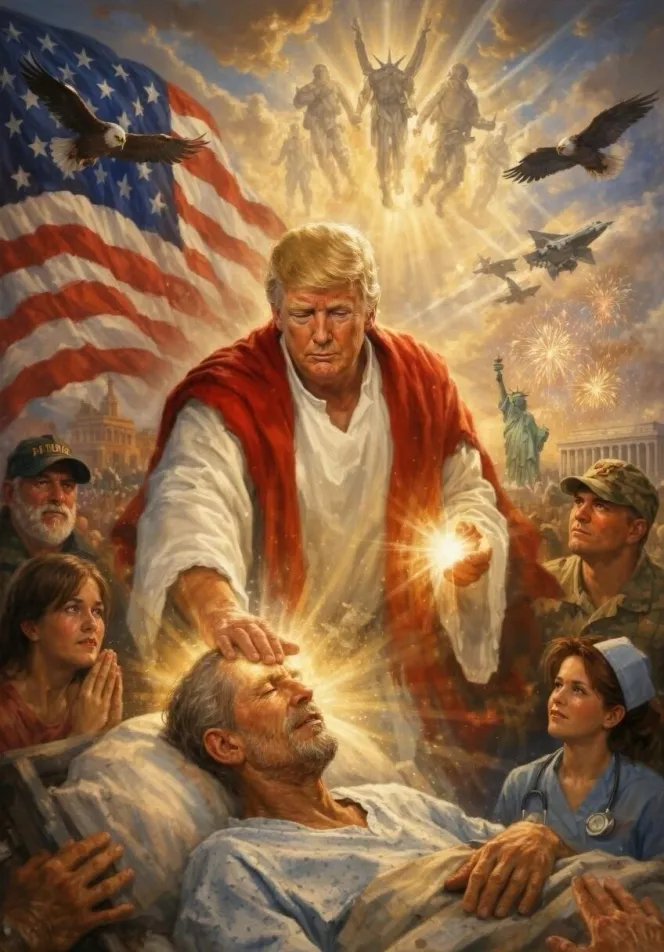 4.13 Donald Trump launches a fierce public attack on Pope Leo, calling him “weak on crime,” “terrible for foreign policy,” and “a very liberal person.” Trump also posted on Truth Social an AI-generated image of himself depicted as Jesus Christ. “I thought it was me as a doctor,” he told reporters.
4.12 Accused of sexual misbehavior, Rep. Eric Swalwell suspends his campaign for California governor. Hours later, he announces that he will resign his seat in the House. Then the similarly accused Rep. Tony Gonzales (R-Texas) similarly resigns.
4.12 President Viktor Orban of Hungary, the European Union’s most pro-Moscow leader, loses presidential election.
4.11 Mark Carney: “Canada’s founding insight is that unity does not require uniformity. . . .Pragmatic decisions that have become a moral conviction — that our differences are a strength to be nurtured, not a risk to be managed.”
4.10 Eliot Engel dies at 79.
4.10 Christopher Hitchens: “Even with all the advantages of retrospect, and a lot of witnesses dead and gone, you can’t make your life look as if you intended it or you were consistent. All you can show is how you dealt with various hands.”
4.10 Mark Blitz in Conversation with Bill Kristol: “Aristotle’s virtues, I think, are still virtues. But when you look at some of the later things called virtues, they do differ from Aristotle. The obvious example is pride as opposed to humility, properly enjoying pleasure as opposed to a kind of asceticism, you might say. Those are some of the obvious differences. And then they’re contemporary, or modern, virtues: responsibility, industriousness, tolerance, which are responsibility and industriousness, maybe you can begin to connect back as kind of democratic versions of Aristotle’s virtues, the others not so easily—toleration, for example. But the point there is that, to the degree to which those are virtues, it’s best, I think, to understand them as versions of Aristotle’s virtues in a democratic era, or a liberal democratic era. And to the degree to which the Christian, or religious, virtues would not be virtues in Aristotle. And in fact, some of his actions would be what he calls “virtue vice.” Well, then one has to make a judgment about what is correct.”
4.9 Afrika Bambaataa dies at 69.
4.9 Fintan O’Toole in NYRB: “[C]utting of the bonds that tie war making to grand geopolitical narratives is a kind of liberation. The agony of America’s post-1945 wars has been their gradual inducement of a sense of futility. The wars stop making sense, and thus the human and financial sacrifices come to seem pointless. What’s happening now under Trump is one sort of answer to the anguish and humiliation of defeat in Afghanistan in his first term. Wars can stop making sense only when they are supposed to make sense in the first place. They become pointless only when there is meant to be a clear point. Futility arises only when a stated goal is not being achieved in spite of all the anguish and effort. If there is no goal—or if, as now, there are so many contradictory objectives that they cancel one another out—nothing can be futile. This negative logic is reinforced by Trump’s own psychological condition. The attack on Iran is what war making looks like in an authoritarian state: not politics by other means but the absence of politics by other means. It is another stage in the working through of a disinhibition that is both institutional (the Republican-dominated Congress refusing to fulfill its constitutional obligation to restrain executive power) and personal (the president’s combination of inherent narcissism with the effects of old age). As Trump told The New York Times in January, he regards himself as unfettered from all constraints except those of “my own morality. My own mind. It’s the only thing that can stop me.” One constraint that used to operate within Trump’s own mind was a squeamish reluctance to get blood on his hands, a fastidiousness about actual killing somewhat akin to his notorious germophobia. We know that this extended in his first term to the idea of bombing Iran. After the Iranians shot down an unmanned American surveillance drone in June 2019, he ordered retaliatory strikes. But when he was told there would likely be 150 casualties, he called the planes back. As he posted on what was then Twitter, “We were cocked & loaded to retaliate last night on 3 different sights [sic] when I asked, how many will die.” Now the specifics of how many will die are no longer of concern to him: unnumbered deaths often happen in war. It is obvious that making war is a useful distraction—for himself as well as for the world—from the Epstein scandal. But it is also now the purest form of self-pleasuring. Usually a president going to war is taking on burdens. Trump is shrugging them off, entering a state of weightlessness where all thought of consequences and all concern for mundane irritants like inflation and affordability are left behind. He declares war from his vacation home at Mar-a-Lago because it is a kind of leisure activity. Strikingly, in rebutting allegations that he will lose interest if the Iran adventure goes on too long, he used a term from his favorite hobby, golf. “I don’t have the yips with respect to boots on the ground,” he told the New York Post.”
4.8 David Frum in The Atlantic: “The most important thing to understand about the “madman theory” of foreign policy is that it was designed by losers for losers. The world first heard of the madman theory from a 1978 memoir by President Richard Nixon’s former chief of staff H. R. Haldeman. According to Haldeman, Nixon said: “I want the North Vietnamese to believe I’ve reached the point where I might do anything to stop the war.” Faced with an otherwise hopeless war in Vietnam, Nixon would pretend to be crazy to intimidate the North Vietnamese into allowing him some face-saving escape. Nobody executes a madman strategy when he feels that he’s winning. Strong and successful powers emphasize consistency and predictability. So do powers that hope to be seen as strong and successful. When China’s foreign minister speaks to the world, he uses language such as “China will be a reliable force for stability” and China “is providing the greatest certainty in this uncertain world.” He understands that true power does not need to boast or yell. Those who feel their power ebbing, however, may bluster and bellow. Over the seven weeks of his Iran war so far, Donald Trump has discovered that no amount of the force at his disposal will calm world energy markets or boost his sagging poll numbers. He has tried a double strategy of promising imminent breakthroughs in negotiations while posting ever more violent threats on social media to ostensibly accelerate those negotiations. But if this was a madman strategy, it signally failed to gain the advantage that he sought. Everyone could see that Trump wanted a deal more than his Iranian counterparts did. A good rule of thumb is that the side that wants a deal more is the side that is losing. The madman strategy is for not-crazy leaders caught in adverse predicaments. It’s a strategy of deception. The madman strategist pretends to be willing to do things that he’s not really willing to do. This approach relies on credibility: Rivals must be able to take the threat of extreme action seriously. Trump’s problems with this strategy are ironic. Foreign leaders are surely willing to believe that Trump is “crazy” in the sense that he is detached from reality. They have seen him miscalculate risk and bungle all kinds of projects, such as his trade wars with China and his attempted coup on January 6, 2021. But they also know that when push really comes to shove, Trump will flinch. TACO has become, like NATO, an acronym so familiar that it no longer needs spelling out.”
4.8 Thomas L. Friedman in the Times: “The artificial intelligence company Anthropic announced Tuesday that it was releasing the newest generation of its large language model, dubbed Claude Mythos Preview, but to only a limited consortium of roughly 40 technology companies, including Google, Broadcom, Nvidia, Cisco, Palo Alto Networks, Apple, JPMorganChase, Amazon and Microsoft. Some of its competitors are among these partners because this new A.I. model represents a “step change” in performance that has some critically important positive and negative implications for cybersecurity and America’s national security. The good news is that Anthropic discovered in the process of developing Claude Mythos that the A.I. could not only write software code more easily and with greater complexity than any model currently available, but as a byproduct of that capability, it could also find vulnerabilities in virtually all of the world’s most popular software systems more easily than before. The bad news is that if this tool falls into the hands of bad actors, they could hack pretty much every major software system in the world, including all those made by the companies in the consortium. This is not a publicity stunt. In the run-up to this announcement, representatives of leading tech companies have been in private conversation with the Trump administration about the implications for the security of the United States and all the other countries that use these now vulnerable software systems, technologists involved told me. For good reason. As Anthropic said in a written statement on Tuesday, in just the past month, “Mythos Preview has already found thousands of high-severity vulnerabilities, including some in every major operating system and web browser. Given the rate of A.I. progress, it will not be long before such capabilities proliferate, potentially beyond actors who committed to deploying them safely. The fallout — economics, public safety and national security — could be severe.’’’
4.8 Jennifer Harris in the Times: “Inequality is such a fact of American life that it’s easy to shrug off. But we are in uncharted terrain. The amassed wealth of today’s tech titans makes the Rockefellers and the Vanderbilts look quaint. Over the past two years, 19 households have added $1.8 trillion to their coffers, the economist Gabriel Zucman told me — roughly the size of the economy of Australia. Into this fragile state enters artificial intelligence. It threatens to make a bad situation much worse. Left on its current course, A.I. could deliver a bleak picture: lower- and middle-income jobs automated away, with top earners remaining unscathed. Income shifting from middle-wage workers doing the bulk of the labor toward those wealthy enough to bankroll the technology. Growth headwinds. Worsening affordability. So, too, a federal government less able to respond, thanks to a shrinking tax base. For any society in which this much wealth gets concentrated in so few hands, and is then so easily parlayed into political clout, the question becomes one not just of economics but of basic civic standing. At some point soon, we are no longer sharing in self-government. Start with A.I.’s impact on jobs. Technologists are convinced that a labor apocalypse is nigh. In this story, A.I. is sometimes posited as a great equalizer, gutting white-collar jobs and salaries, giving more clout to trades like plumbing and dimming the luster of that Ivy League degree. The theory has gotten the nod from academics, industry associations and institutions such as the O.E.C.D. In truth, whether A.I. will lead to widespread job loss remains guesswork. But the notion that it will narrow inequality by pushing downward on top earners seems far-fetched. What’s already clear: As A.I. transforms anything touching a keyboard, it will land first and hardest on the income ladder’s middle and lower rungs. The jobs most at risk, say government forecasters and economists, are administrative and office support staff, sales and lower-level computer programmers — all roles with salaries of $40,000 to $100,000. Those losses on the lower half of the scale are underway. One-quarter of computer programming jobs disappeared in 2023 and 2024. IBM’s chief executive said in 2023 he could “easily see” 30 percent of the company’s back office roles getting replaced by A.I. in the next five years. With at least three major rounds of job cuts in 2024 and 2025, IBM appears to be following through on that idea (though it has also signaled plans to grow entry-level hiring). A Stanford study found that early-career employees in A.I.-exposed fields like customer service have seen a 13 percent drop in employment since 2022 — unlike more experienced workers and those in other sectors.”
4.9 After Trump‘s tweet about Iran is criticized by leading conservative podcasters Tucker Carlson, Megyn Kelly, Candace Owens and Alex Jones, he assails them on Truth Social: “They have one thing in common, Low IQs. They’re stupid people, they know it, their families know it, and everyone else knows it, too!”
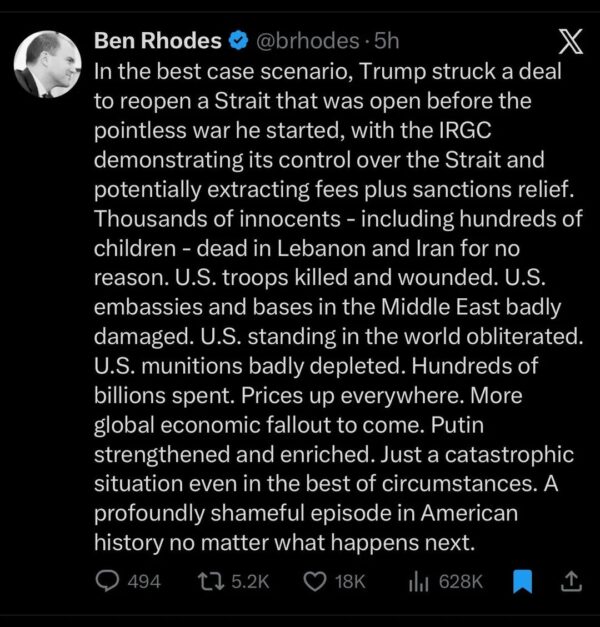 4.8 Heather Cox Richardson: “Trump’s threat that “a whole civilization will die tonight, never to be brought back again” was not just a reference to Iran. If he had destroyed Iran in our names, unhampered by the Republican Congress members who have vowed to defend the U.S. Constitution, it would also have been an epitaph for the United States of America.”
4.8 Robert Reich: “Trump has really, seriously, frighteningly lost his mind. It won’t happen soon, but if Trump continues to deteriorate, Republicans won’t have any alternative but to remove him from office. Neither will America.”
4.7 Trump backs off his threat, declares two week cease fire.
4.7 David A. Graham in The Atlantic: “Trump’s message this morning is also notable for the autocratic view that underpins it. His position is that if he wants to wipe out “a whole civilization,” then that is his decision to make—unconstrained by American law, international law, Congress, or public opinion. “Only President Trump knows what he will do, and the entire world will find out tomorrow night if bridges and electric plants are annihilated,” the White House spokesperson Anna Kelly told The Wall Street Journal. This view is legally, morally, and practically 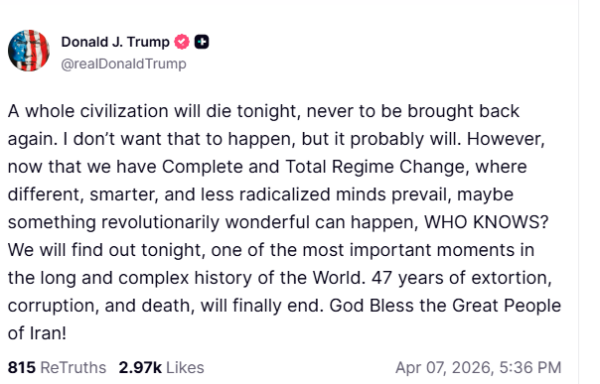 disastrous. Such action by the president is not what the Framers of the Constitution laid out. They granted the power to declare war to Congress alone, as my colleague Quinta Jurecic has written: “That design choice represented a radical break from the monarchies of Europe, where kings and queens had the ability to decide when to mobilize their countries to war.” That separation of powers has gradually eroded over decades, but Trump’s war in Iran goes a step beyond what previous presidents have done. The unilateral decision to erase a civilization would go a huge step past that.”
4.6 Pete Hegseth, annoucing the recovery of a downed airman in Iran: “One downed airman evaded capture for more than a day, scaling rugged ridges while hunted by the enemy. When he was finally able to activate his emergency transponder, his first message was simple, and it was powerful. He sent a message: ‘God is good.’ In that moment of isolation and danger his faith and fighting spirit shown through. You see, shot down on a Friday, Good Friday. Hidden in a cave. A crevice, all of Saturday. And rescued on Sunday, flown out of Iran as the sun was rising on Easter Sunday. A pilot reborn, all home and accounted for, a nation rejoicing. God is good.”
4.5 Easter brunch at Prologue
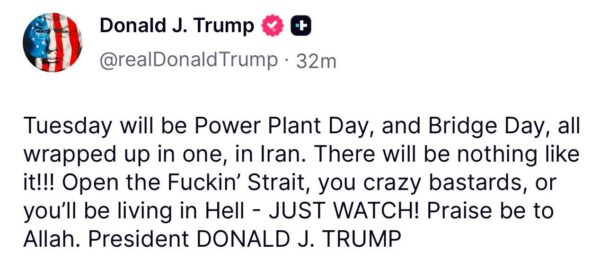
4.5 Heather Cox Richardson: “The post appears to be threatening to commit war crimes by attacking civilian infrastructure, and it appears to suggest Trump is considering using tactical nuclear weapons.”
4.5 Marjorie Taylor Greene: “Everyone in his administration that claims to be a Christian needs to fall on their knees and beg forgiveness from God and stop worshipping the President and intervene in Trump’s madness. I know all of you and him and he has gone insane, and all of you are complicit.”
4.5
4.4 In a 1-0 Los Angeles victory over Seattle, Angels outfielder Jo Adell made three leaping catches that took away home runs. On the third catch, Adell toppled over the short wall in right field into the stands. Legendary defensive center fielder Torii Hunter, now a special assistant with the Angels: “That’s probably the greatest defensive game I’ve ever seen.”
4.2 Project Hail Mary
4.2 Trump ousts Bondi.